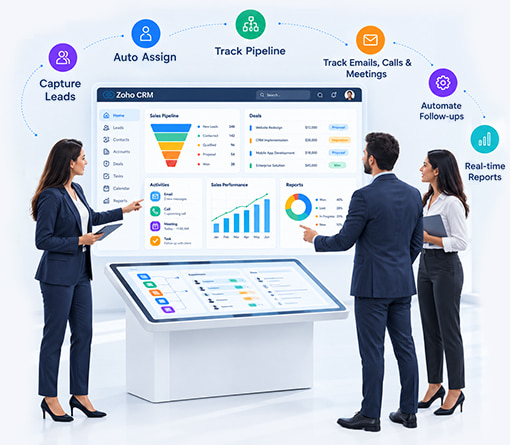
Most Zoho CRM implementations fail — not because of the software, but because they were configured out of the box. We build Zoho CRM around how your team actually sells — custom pipeline stages, smart automation, and integrations with your existing tools. The result is a CRM your sales team actually uses.
These are the six problems we find in almost every Zoho CRM audit we run — and all of them are fixable.
Generic pipeline stages. Default fields nobody uses. Layouts that don't reflect how your team sells. A CRM that forces your team to adapt to it, instead of the other way around. Most Zoho setups are never properly customised — and adoption suffers because of it.
Deals tracked in personal spreadsheets. Calls not logged. Follow-ups forgotten. If the CRM doesn't make the sales team's job easier — they won't use it. Adoption is a design problem, not a discipline problem. The right configuration makes using the CRM the path of least resistance.
Email not syncing. Calendar invites not logging. New leads from your website not flowing in. Every disconnection creates manual work — and manual work creates gaps in your data. A properly integrated CRM logs activities automatically.
Follow-up emails sent one at a time. Lead assignments done by hand. Proposal reminders set manually in calendars. Zoho CRM's automation engine is powerful — but only if it's configured. Most installations leave it entirely unused.
The default Zoho reports show activity counts. They don't show pipeline velocity, deal conversion by rep, forecasting accuracy, or revenue at risk. Leadership is making decisions from gut feel when the data to make better decisions is already in the system.
Duplicate companies. Contacts with no associated deals. Deals in the wrong stage. Incomplete records from a migration that was never cleaned up properly. Poor data quality means poor reporting, poor automation trigger accuracy, and a CRM nobody trusts.
An AI chatbot answers questions.
An AI agent goes further — it takes action inside your systems.
Not generic setup. Each element is configured to your specific sales process, your team, and your business rules — before a single rep opens the system.
Before we touch a single configuration screen, we map your actual sales process — every stage, every trigger, every decision. Your pipeline stages reflect real milestones your deals pass through, not Zoho's default template. Stage probability, required fields per stage, and exit criteria all configured.
Every business has information that doesn't fit in standard CRM fields. We build custom modules and fields for your specific data — product configurations, project types, compliance flags, industry-specific data — so your CRM captures what you actually need to know about each deal.
Automated lead assignment based on territory, industry, or rep capacity. Follow-up sequences triggered by deal stage movement. Task creation when a deal stalls. Notification workflows keeping the right people informed. Everything that happens manually today — configured to happen automatically.
Gmail or Outlook email sync — every sent email logged against the right deal automatically. Calendar integration — meetings appear in the CRM timeline. Website lead forms flowing directly into the pipeline. WhatsApp, telephony, and third-party tools connected via Zoho's integration layer or custom API.
Pipeline health dashboard showing deals by stage, value, and rep. Conversion rate reporting from lead to close. Revenue forecasting with configurable probability weighting. Activity tracking. Zoho Zia AI insights enabled and configured — so the CRM tells your team what to act on next.
Task-based training — not a feature tour. We train your team on their actual workflows: "how to move a deal forward," "how to log a call," "how to read your pipeline dashboard." Admin training delivered separately. Aayushi available for post-launch support questions directly.
These are live implementations we've built for clients. Specific setups, specific results.
A UK professional services firm was tracking all deals in a spreadsheet. No pipeline visibility, no activity logging, no forecasting. We mapped their 6-stage sales process — from first contact to retainer signed — and built a custom Zoho CRM configuration around it. Custom fields for service type, engagement scope, and decision-maker mapping. Automated follow-up sequences triggered at each stage. Email and calendar integration so every client interaction was logged automatically.
A technology company was paying enterprise Salesforce licences for a 12-person sales team — more than half the functionality unused, and maintenance costs compounding. We managed the full migration to Zoho CRM: data audit and deduplication, field mapping, custom object re-creation, workflow recreation, and a two-week parallel run before full cutover. Zero data loss. Zero downtime. Team trained and operational on day one of go-live.
A B2B SaaS company had web forms feeding leads into a general email inbox — someone would periodically check the inbox, manually enter the lead into Zoho, and assign it to a rep. Leads were sitting uncontacted for hours. We built a fully automated lead intake and routing system: form submission → Zoho lead created instantly → enriched with company data → scored against their ICP → assigned to the right rep → personalised follow-up email sent. All in under 90 seconds, zero human touch for the routing.
A manufacturing company had been paying for Zoho CRM for three years but the sales team was still doing everything in spreadsheets. The CRM had default Salesforce-style stages that meant nothing in their business, no email sync, no automation, and data from the original import that was never cleaned. We ran a full audit, identified the six root causes of non-adoption, rebuilt the configuration around their actual process, cleaned the data, and ran a structured re-adoption programme. Within 6 weeks, 100% of deals were tracked in the CRM.
A SaaS company's sales team was closing deals without knowing the customer had 3 open support tickets. Their support team was handling complaints without knowing the customer was mid-renewal negotiation. We integrated Zoho CRM and Zoho Desk to create a single customer view — every support ticket visible in the CRM deal record, every contract detail visible to support agents. Sales and support finally speaking the same language about the same customer.
Most Zoho CRM implementations leave Zia AI entirely unconfigured — it's available in every Zoho CRM Professional+ licence and almost nobody uses it. We configure Zia to work with your specific data: lead scoring trained on your historical win/loss patterns, deal anomaly detection flagging stalled or at-risk deals, email sentiment analysis alerting reps to negative signals, and best-time-to-contact predictions based on your customers' engagement patterns.
An AI chatbot answers questions.
An AI agent goes further — it takes action inside your systems.
We spend the first week mapping how you actually sell before touching a single configuration screen. Your stages, your fields, your rules.
We involve the sales team in design, train on real workflows, and measure adoption explicitly as a project success metric. A CRM nobody uses isn't a CRM.
Lead routing, follow-up sequences, proposal reminders, activity logging — configured before go-live so manual work disappears on day one.
Every client has a named Zoho consultant who knows their setup. Questions get answered by someone who built your system — not by a generic helpdesk.
We're an Authorised Zoho Partner — but with a 23-year engineering company behind us. We can build custom integrations, APIs, and extensions that a pure Zoho reseller can't.
NDA before day one, ISO 27001 certified, and honest advice on whether Zoho CRM is the right fit before any project is proposed.
Every engagement starts by understanding your sales process — not by touching Zoho. We configure before we demo. We demo before we train. We train before we go live.
We map your actual sales process — stages, triggers, decision points, team structure. The CRM is designed around this map, not around Zoho defaults.
Pipeline, modules, fields, automation, integrations — all built and tested in a sandbox before touching your live environment. You review and approve.
Data migrated, cleaned, and validated. Two-week parallel run — old and new systems live simultaneously until the team has confidence in the new setup.
Task-based training for reps, admin training for managers. Adoption tracked as a KPI. Aayushi available for direct questions post-launch.
You have a Zoho CRM licence. Your team isn't using it. You're managing sales from email threads and spreadsheets and you have no reliable pipeline view. We fix the implementation so your team actually adopts it — and you get the visibility you've been missing.
You're growing and the manual parts of your sales process are becoming a ceiling. Lead routing, follow-ups, proposal reminders, activity logging — all happening by hand. You need the automation infrastructure to support 2× the current volume without 2× the headcount.
You're on a Salesforce contract that made sense at a different company stage. You're using 20% of the features and paying enterprise rates for a 15-person sales team. We manage the full migration to Zoho — your data, your pipeline, your automations — at a fraction of the cost.