
What Is MCP (Model Context Protocol)? A Practical Enterprise Guide
14 Jan
Large organizations can now safely connect AI models to their internal systems without creating security, scalability, or governance risks. As enterprises accelerate AI adoption, this has become critical.
According to recent industry research, over 75% of enterprises experimenting with generative AI struggle to operationalize it beyond pilots due to data access, security and integration complexity.
If you are a CIO, CTO, Head of Engineering, or Security Leader, MCP directly impacts how safely, quickly, and compliantly your enterprise can adopt and scale AI capabilities.
This blog explains what MCP is, how it works, why it matters for enterprises and when it makes sense to adopt professional MCP consulting.
Model Context Protocol (MCP) is an open protocol that standardizes how AI models and agents securely access external tools, data sources and services. Instead of hard-coding integrations between every AI model and every enterprise system, MCP defines a consistent interface for context exchange.
While MCP defines an open standard, enterprise adoption still requires careful architecture design, security modelling and system integration.
In simpler terms:
MCP is especially relevant in environments where AI must interact with CRMs, ERPs, and internal databases, file systems and document repositories, APIs, microservices, and SaaS tools, workflow engines and automation platforms.
Rather than embedding custom connectors inside applications, organizations are turning to MCP implementation services to externalize context access into governed, reusable services.
Before MCP, most AI system integration relied on a few common patterns.
While these approaches often worked in early pilots or proofs of concept, they struggled to hold up under real-world enterprise requirements such as security, compliance, scalability, and long-term maintainability.
In this approach, AI applications connect directly to enterprise systems through APIs. While this is fast to prototype, it becomes difficult to secure and manage at scale. Each agent requires its own credentials and error handling, making secure AI integration services difficult to maintain.
Example: An internal AI copilot directly calling a CRM API to fetch customer data may work initially, but as more copilots are added, managing permissions, rate limits and audit logs quickly becomes unmanageable.
Many enterprises introduce custom middleware layers tailored to specific AI use cases. While this provides more control, it is expensive to build and difficult to scale across teams. Each new workflow often requires new middleware logic, creating fragmentation.
Example: A sales AI assistant and a support AI assistant might each use separate middleware services to access the same customer database, duplicating logic and increasing maintenance overhead.
Copying data directly into prompts is fragile and risky. It lacks governance, making it nearly impossible to enforce consistent data access policies, a key reason why enterprise AI consulting services prioritize moving away from this method.
Example: Copying customer records or financial summaries into prompts may expose sensitive data and makes it nearly impossible to enforce consistent data access policies.
These approaches break down quickly in enterprise environments because they:
MCP was designed to address these systemic issues by separating AI reasoning from enterprise context delivery.
Instead of embedding access logic inside AI applications, MCP introduces a standardized, governed layer that securely delivers context to AI models.
This enables enterprises to scale AI adoption while maintaining control, consistency and compliance across systems.

To understand how enterprise MCP solutions function, it helps to break down the building blocks:
These are AI-powered applications or agents that need external context. Examples include:
The client does not directly access enterprise systems. Instead, it requests context via MCP.
An MCP server exposes tools, data, or actions in a controlled way. Each server can implement the MCP specification, defines what data or actions are available and enforces access rules and boundaries.
For example, an MCP server might expose:
Within MCP, tools represent actions (e.g., create, update, trigger), while resources represent data (e.g., files, records, documents). This distinction is important for enterprise governance because it:
MCP defines how context is described, requested and returned, allowing consistent AI behaviour across tools, Vendor-agnostic model usage and easier replacement or upgrade of models.
Model Context Protocol (MCP) delivers value beyond technical operations. For enterprises operating at scale, it addresses some of the most persistent challenges in deploying AI safely, consistently, and efficiently.
Below are the key benefits of MCP.
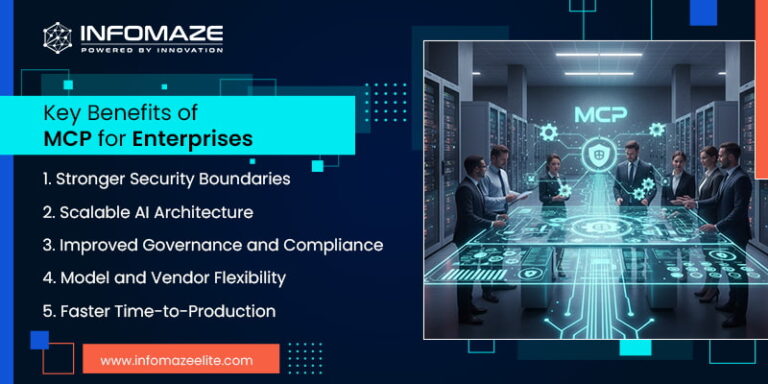
Security is one of the primary reasons MCP exists. Enterprise systems were never designed to grant unrestricted access to autonomous AI agents, and MCP introduces clear, enforceable boundaries.
MCP reduces risk by:
Instead of injecting sensitive data directly into prompts, MCP ensures that data remains behind controlled interfaces and is accessed only when explicitly authorized.
For example an AI assistant querying customer records through an MCP server can be limited to read-only access for specific fields, rather than full database exposure.
As AI adoption grows, enterprises often struggle with architectural sprawl. MCP enables a more scalable and repeatable approach to AI system design.
With MCP in place:
This is especially critical for large organizations running dozens of AI initiatives across departments such as sales, support, operations, and compliance.
A single MCP integration with an ERP system can serve multiple AI agents, from finance forecasting to procurement optimization, without duplicating effort.
For enterprises in regulated industries, governance is not optional. MCP introduces structure and visibility into how AI systems interact with enterprise data.
MCP supports governance by:
Every interaction between an AI model and enterprise systems can be logged and reviewed. This turns AI behavior from a black box into an inspectable process.
For instance, compliance teams can review which AI agents accessed financial or healthcare data, when and for what purpose.
MCP decouples AI reasoning from underlying tools and data sources. This separation gives enterprises freedom in how they adopt and evolve AI technologies.
With MCP, organizations can:
As AI ecosystems evolve rapidly, this flexibility becomes a strategic advantage.
For example an enterprise might use one model for internal knowledge search and another for customer-facing interactions, all accessing the same MCP-governed tools.
Many AI initiatives fail to move beyond pilots due to integration complexity. MCP reduces this friction by standardizing how context is delivered to models.
By using MCP:
This shortens development cycles and increases the likelihood that AI projects deliver measurable business value. A proof-of-concept AI workflow can be promoted to production using the same MCP interfaces, without rewriting access logic or compromising security.
| Aspect | Traditional Integration | MCP-Based Integration |
|---|---|---|
| Security | Model accesses APIs directly | Controlled MCP servers |
| Scalability | Custom per use case | Reusable across teams |
| Governance | Limited visibility | Centralised policies |
| Flexibility | Tightly coupled | Loosely coupled |
| Maintenance | High | Lower over time |
For enterprises, MCP (Model Context Protocol) is less about features and more about architectural discipline.
It introduces a standardized way to connect AI systems with enterprise environments while keeping control, performance and scale in mind. Below are reasons to choose MCP, grounded in technical considerations.
MCP provides a uniform contract for how AI models access tools and data. This removes inconsistencies across teams and ensures every AI system follows the same integration rules, regardless of use case.
All permissions, policies and constraints are enforced at the MCP layer. This allows security teams to manage access centrally instead of embedding rules inside individual AI applications.
MCP decouples AI logic from backend systems. Changes to APIs, databases or services can be handled at the MCP layer without modifying AI workflows or prompts.
Once an MCP server is implemented for a system like a CRM or ERP, it can be reused across multiple AI agents and applications, reducing duplication and long-term maintenance effort.
MCP enables logging and monitoring of AI-to-system interactions. This supports enterprise requirements for traceability, debugging and operational oversight.
Enterprises can run different AI models for different workloads while using the same MCP integrations, enabling flexibility without architectural fragmentation.
Rather than relying on process alone, MCP enforces governance through design. Data access paths are explicit, controlled and auditable by default.
By avoiding prompt-based data injection and direct system access, MCP reduces the risk of data leakage, misuse and unpredictable model behavior in production.
Model Context Protocol represents a shift in how enterprises think about AI integration. Instead of embedding intelligence everywhere, MCP creates a controlled, scalable and governed bridge between models and systems.
For organisations serious about enterprise AI, beyond demos and proofs of concept, MCP offers a practical path forward. It aligns AI innovation with the realities of security, compliance and operational scale.
Operationalizing AI securely is an architectural challenge, not a tooling problem.
Infomaze works with enterprises to design and implement MCP-ready AI architectures that meet security, compliance, and scale requirements from day one. Our MCP integration services turn fragmented AI initiatives into secure, production-grade systems.


Disclaimer: All rights belong to the owner. No Copyright or Trademark Infringement Intended.
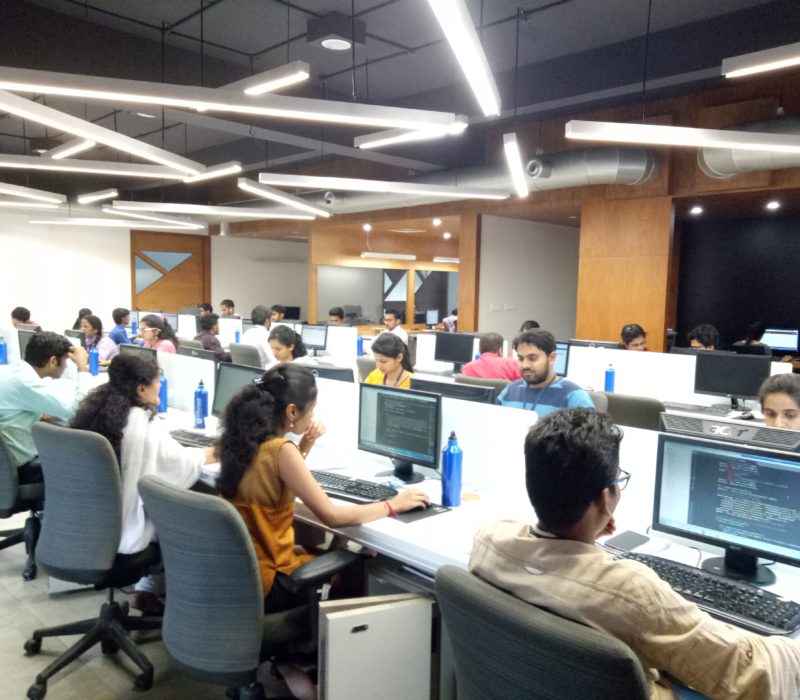
Ultra New, Uber-Cool Workspace with Informal Areas New environment, more creative ideas! Infomaze’s new ...

Having started its growth in a developing country like India, Infomaze has had many options to settle in. It ...
In the era where technology is ruling this world, digitization and automation are in full swing in the field ...
Just like updating ourselves over time, updating your business software is also equally important. In ...

If you are still using the file manager versions 6.0 – 6.8 on WordPress, you need to upgrade immediately, ...