As enterprises scaled AI across underwriting, risk, fraud detection and customer operations, traditional prompt-based integrations exposed a critical weakness. We addressed this challenge by redesigning AI integration at the architectural level.
Through our specialized MCP implementation services, we established a controlled, policy-enforced layer between AI models and regulated systems.
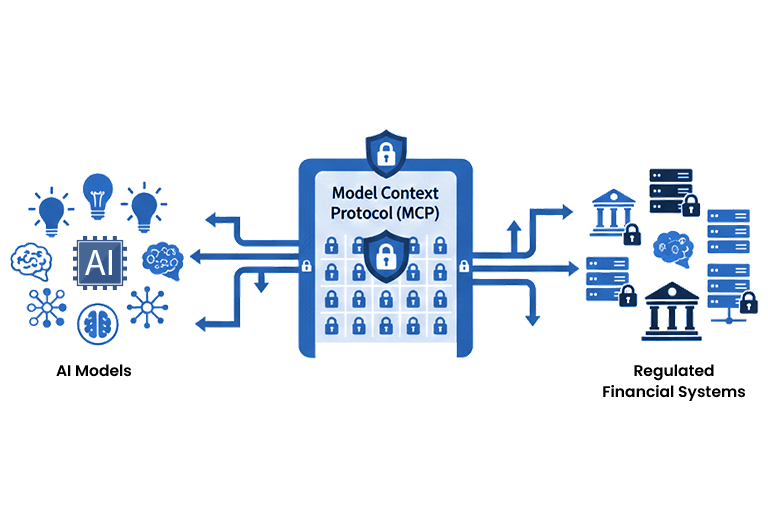
The client is a multi-line services organization operating across lending, insurance underwriting, and claims management. They manage millions of customer records, and require robust AI systems integration to connect with core enterprise systems, CRMs, underwriting engines, and operate under strict regulatory frameworks such as SOC 2, ISO 27001 and regional data residency laws.
Teams built isolated workflows, leading to inconsistent enterprise AI integration and duplicated logic across departments.
Sensitive enterprise and PII data was passed directly into AI prompts, bypassing least-privilege controls and increasing audit and compliance risk.
AI-assisted underwriting and risk decisions lacked complete interaction logs, making regulatory reviews and decision traceability difficult.
Each new AI use case required custom integrations with enterprise systems, slowing rollout and increasing operational overhead.
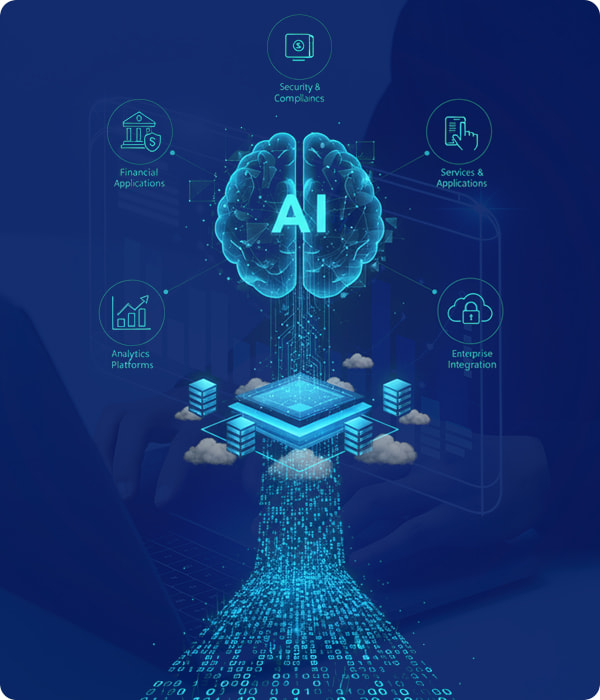
We architected and implemented a Model Context Protocol implementation services framework to decouple AI models from backend systems while maintaining strict governance.
We built a dedicated MCP server as the sole execution path for all AI implementation services.
This ensured models could reason over data without holding execution privileges.
Our AI integration consulting team engineered granular tools aligned to specific functions.
Each tool operated within tightly defined functional and compliance boundaries.
By implementing runtime context abstraction and using our Model Context Protocol implementation services, we eliminated "prompt stuffing.”
This reduced data exposure while preserving decision accuracy.
We embedded full-fidelity audit logging across all MCP interactions.
AI activity became transparent, explainable, and regulator-ready.
Infomaze designed MCP tooling as shared enterprise AI solutions, not isolated integrations.
This significantly reduced integration effort and long-term technical debt.
The MCP layer abstracted models from backend systems, enabling vendor-agnostic AI adoption.
AI innovation could evolve independently of system risk.
Reduction in time required to launch new AI use cases
Zero direct exposure of sensitive enterprise data to AI models
Improved regulatory readiness with auditable AI decision logs
Consistent AI behavior across underwriting, claims, and CX teams
Lower operational risk from uncontrolled AI experimentation
Implementing MCP in a regulated enterprise is not a tooling exercise, it is a systems architecture, governance and risk-engineering challenge. Infomaze provides the high-level AI integration consulting required to execute this at scale.
We do not retrofit AI onto legacy systems. We redesign the integration layer itself ensuring AI operates within enterprise-grade constraints such as least-privilege access, deterministic tooling, and policy enforcement.
Our AI implementation services have been delivered under SOC 2 and ISO 27001 mandates.
Infomaze operationalizes governance at the MCP layer—where execution, data access, and policy enforcement actually occur. This avoids fragile prompt-based guardrails and ensures controls remain intact as models evolve.
We build MCP tooling as shared enterprise services, not project-specific integrations. This allows organizations to scale AI horizontally across business units without multiplying risk, cost, or complexity.
Our AI systems integration approach is model-agnostic, allowing you to switch AI providers without re-engineering your backend.

For senior leaders, the MCP architecture is not a technical preference, it is a risk, governance and growth decision.
For enterprise services organizations, AI success is no longer about experimentation, it is about controlled scale. By implementing MCP implementation services, we enabled the enterprise to operationalize AI while preserving regulatory compliance, governance controls, and architectural flexibility.
MCP evolved from a technical integration layer into a strategic foundation for enterprise AI governance and scale. Ready to implement governed, enterprise-grade AI? Partner with Infomaze to design MCP-based architectures that align AI innovation with security, compliance, and business scale.
Let us know! Our product experts can configure the best solution for your business.