
What Is MCP (Model Context Protocol)? A Practical Enterprise Guide
14 Jan
The global enterprise AI market is accelerating at an unprecedented rate. According to IDC, over 85% of enterprises will increase their investments in artificial intelligence by 2026.
These numbers confirm a clear reality that AI transformation is a strategic business mandate.
As enterprises move into Digital Transformation 2026, leaders must shift from scattered AI experiments to well-defined, scalable frameworks.
Organizations achieving the highest ROI treat AI not as a temporary upgrade but as a core pillar of their business transformation strategy.
A structured AI transformation roadmap enables enterprises to harness the full potential of Enterprise AI, ensuring long-term adaptability, operational resilience, and continuous innovation.
Below are five reasons why every large organization must define a roadmap before stepping into the next growth cycle.
One of the biggest challenges enterprises face today is siloed implementation. Different teams experiment with isolated AI solutions without a shared direction, resulting in fragmented tools, redundant spending, and inconsistent outcomes.
A unified AI strategy for enterprises solves this problem by:
With a structured AI implementation roadmap, decision-makers gain a clear, actionable blueprint rather than relying on trial-and-error deployments. This ensures AI does not simply automate tasks but drives enterprise-wide value.
Additionally, alignment supports smoother AI adoption strategy execution since employees, leadership teams, and technology stakeholders operate under a shared vision.
This reduces internal resistance, accelerates ROI, and ensures AI initiatives serve measurable business goals.
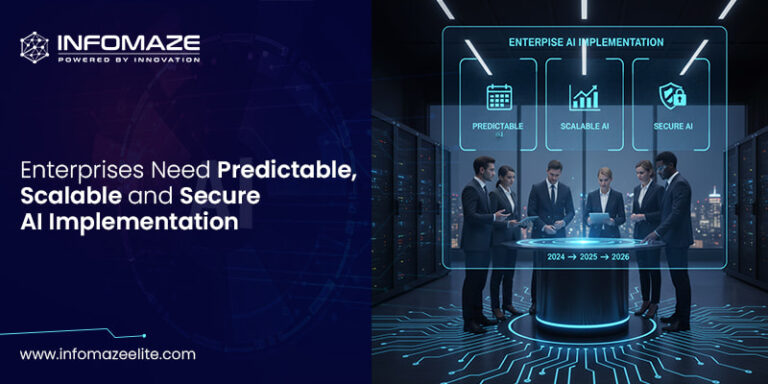
In 2026, cybersecurity, scalability, and compliance will define the future of AI in enterprises. As businesses adopt intelligent automation, machine learning models, and generative AI systems, risks become more complex.
Enterprises must address:
A well-designed AI transformation roadmap provides structured governance to mitigate risks before they escalate. It includes:
Ensuring data encryption, access control, and secure model management.
Supporting evolving regulatory requirements around artificial intelligence in business.
So AI solutions can grow with large organizations without re-engineering core systems.
This is where enterprises must shift from ad-hoc pilots to strategic frameworks that safeguard both technology and business continuity.
2026 will be a defining year where efficiency becomes the currency of competitiveness. Enterprises adopting AI transformation find significant reductions in operational costs and human effort.
A roadmap ensures organizations identify high-impact areas such as:
By prioritizing these use cases within an AI adoption strategy, enterprises gain visibility into:
Moreover, a structured plan allows leadership to shift from reactive operations to proactive, insight-driven decision-making, enhancing agility during market disruptions.
For a company like Infomaze, building AI-driven enterprise systems often highlights measurable improvements such as:
With a scalable AI implementation roadmap, organizations unlock these results consistently across departments.
In the enterprise world, customer expectations are evolving faster than traditional systems can adapt. Personalized experiences, real-time insights, and intelligent automation are now baseline requirements.
AI empowers enterprises to deliver:
However, without a clear AI strategy for enterprises, customer experience initiatives remain inconsistent or underdeveloped. A roadmap ensures:
Mapping AI use cases to every customer touchpoint—from marketing to onboarding to support.
Using predictive and generative AI to enhance satisfaction and retention.
Companies with mature AI capabilities position themselves as industry leaders, offering innovative services competitors cannot match.
In Digital Transformation 2026, enterprises that integrate intelligent features into products and services will outperform those relying on traditional, manual processes. A roadmap ensures this transformation remains structured, efficient, and aligned with customer demands.
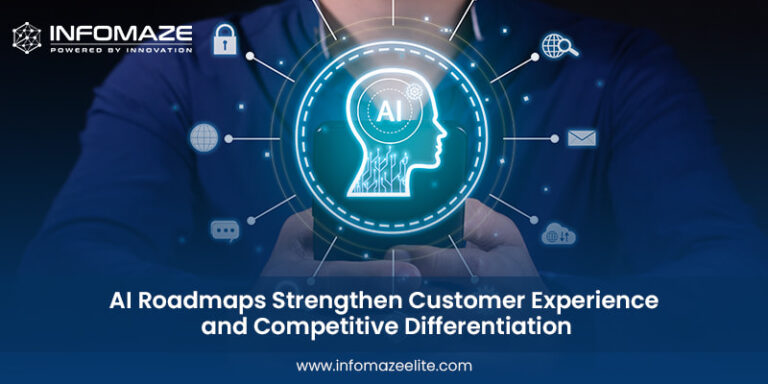
The future of AI in enterprises is rapidly shifting towards more autonomous systems, self-learning algorithms, and AI-powered decision engines. From GenAI copilots to fully automated digital ecosystems, the next decade will redefine how global enterprises operate.
Organizations without a roadmap risk falling behind.
A strong AI transformation framework prepares enterprises for emerging capabilities such as:
A forward-looking AI implementation roadmap ensures enterprises build modular, adaptive AI systems that evolve with new technologies rather than requiring complete reinvention.
As a development company, Infomaze emphasizes building flexible, future-ready architectures that support continuous expansion. The goal is not just to implement AI, it is to establish a foundation that embraces innovation for years to come.
This is where a strategic roadmap becomes invaluable: it ensures the enterprise moves confidently from AI experimentation to enterprise-grade intelligence, unlocking long-term growth and resilience.
In 2026, the enterprises winning the AI race will not be the ones experimenting with scattered tools but those with a clear, measurable, and scalable roadmap. Whether improving operational workflows, strengthening customer experiences, or future-proofing the organization, an AI transformation roadmap acts as the anchor for sustainable success.
It supports every critical area of enterprise growth and long-term innovation readiness.
As artificial intelligence in business continues accelerating and enterprises navigate Digital Transformation 2026, having a structured plan will determine who leads and who falls behind.
Infomaze supports enterprises in designing and implementing intelligent, adaptable, and secure AI systems aligned with their broader business transformation strategy. But the real power lies in the roadmap itself: the blueprint guiding every step of enterprise innovation.
The next wave of enterprise evolution is here. Now is the time to define and adopt AI software development solutions and build an actionable roadmap.



Disclaimer: All rights belong to the owner. No Copyright or Trademark Infringement Intended.

Ultra New, Uber-Cool Workspace with Informal Areas New environment, more creative ideas! Infomaze’s new ...

Having started its growth in a developing country like India, Infomaze has had many options to settle in. It ...
In the era where technology is ruling this world, digitization and automation are in full swing in the field ...
Just like updating ourselves over time, updating your business software is also equally important. In ...

If you are still using the file manager versions 6.0 – 6.8 on WordPress, you need to upgrade immediately, ...