Solar installers need to manage far more than leads. A single project can involve consultation, site inspection, quotation, equipment, scheduling, installation, documentation, invoicing, warranties and ongoing service.
One of our solar clients was managing these activities across spreadsheets and disconnected processes. Infomaze designed a connected Zoho environment that brought CRM, field inspections, inventory, documents, approvals and finance into one operational workflow - from the first enquiry through installation and after-sales service.
Solar Energy – Residential & Commercial
Solar Panel Installation, Monitoring & Maintenance
Replace fragmented spreadsheets and manual processes with a connected Solar CRM and operations platform.
The company was managing important operational information through spreadsheets and other disconnected processes.
As the business grew, manually maintaining and cross-referencing this information became increasingly inefficient.
The requirement was therefore bigger than implementing a traditional sales CRM.
The company needed a system connecting sales, field operations, installation, inventory, documentation and finance.
The requirement extended beyond lead and opportunity management. The business also needed field inspection forms, equipment records, document generation, digital signatures and accounting. Rather than forcing all of this into CRM, we used the relevant Zoho applications for each function and connected them around one solar project workflow.
Zoho CRM remained the central customer and opportunity layer, while Creator, Inventory, Writer, Sign and Books handled the operational processes around it.

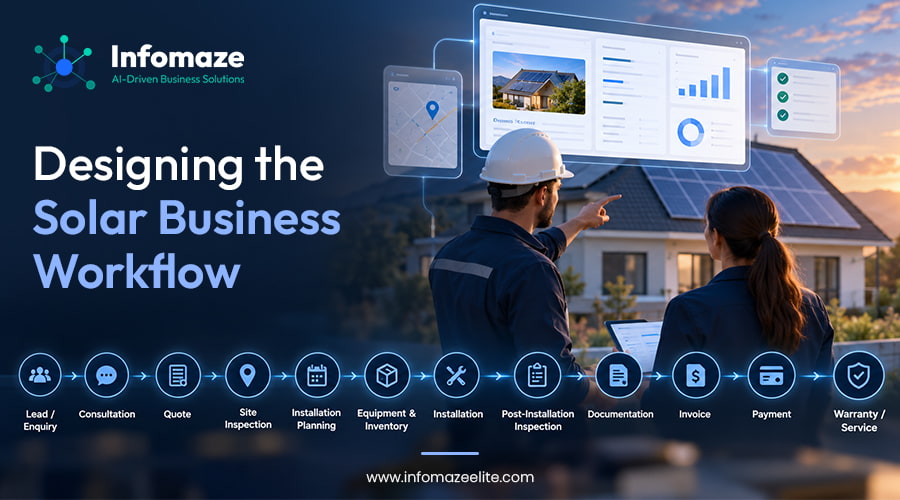
We first mapped the operational journey so that information could move through the business instead of being repeatedly entered into different systems.
A simplified workflow looked like this:
Zoho applications were then configured around this process.
Zoho CRM was customized to provide a central record for leads, prospects and customers.
The system enabled the team to maintain customer information together with appointments, opportunities, installation information and related activities.
Instead of searching across different files, employees could work from a structured customer and project history.
Solar installations require information to be captured at the customer's location.
We created customized forms using Zoho Creator for field teams to record pre-inspection and post-inspection information.
This allowed information collected on-site to become part of the digital customer and installation record rather than remaining on paper or in separate files.
Inventory is an important part of solar operations.
Zoho Inventory was incorporated into the solution to help maintain information relating to solar panels, batteries and other equipment associated with installations.
This helped connect operational requirements with available inventory.
The solution also supported quotation and document workflows.
Information already available within the system could be used to generate business documents, reducing repeated manual data entry.
Zoho Writer and related applications were integrated into the workflow for document generation and management.
Where documents required customer approval or signatures, Zoho Sign was integrated into the process.
This provided a more connected flow between customer records, documentation and approvals.
Consultations, installation appointments and other important activities could be tracked within the system.
This gave teams better visibility into upcoming customer commitments and reduced dependence on separate schedules and manual reminders.
The solution was designed not only around acquiring and installing solar systems but also around the ongoing relationship with the customer.
Product warranties, performance information, inspections and subsequent service activities could be associated with the relevant customer and installation.
This created a more complete lifecycle record.
Zoho Books was incorporated into the solution to connect operational activities with finance.
Invoices could be generated based on relevant products, services and billable hours, while the finance team could manage transactions, payments, bills and banking information within the broader Zoho ecosystem.
The solution extended beyond basic CRM configuration, connecting customer management, field operations, inventory, documents, approvals, finance, and after-sales service into one workflow.
| Area | What We Configured / Customized |
|---|---|
| CRM | Solar-specific customer, opportunity, installation, and activity records |
| Field Operations | Pre- and post-installation inspection forms built in Zoho Creator |
| Inventory | Solar panels, batteries, and installation equipment linked to operational workflows |
| Documents | Quote and document generation using business data already captured in Zoho |
| Approvals | Zoho Sign connected to customer and document approval workflows |
| Finance | Invoice generation using products, services, and billable hours |
| Service | Warranty, inspection, and maintenance history linked to the customer and installation |
The important part of this implementation was not any single Zoho application. It was the integration between them.
Instead of operating CRM, inspections, inventory, documents and accounting as independent processes, information could flow between different stages of the business.
The resulting environment connected:
CRM + Field Operations + Inventory + Documents + Digital Signatures + Accounting
This reduced duplicate data entry and made it easier for teams to access the information associated with a customer or solar project.
We can map your current lead-to-installation workflow and show where Zoho CRM, Zoho One or a custom integration can remove duplicate work.
Most importantly, the CRM became more than a sales database. It became part of the company's operational system.
The main change was visibility. Sales, field operations and finance no longer needed to maintain separate versions of the same customer or installation information. Each stage could use information already captured earlier in the workflow, reducing duplicate entry and making the CRM part of day-to-day operations rather than only a sales database.
If verified project data is available later, add measurable results such as reduction in duplicate entry, quote turnaround time, missed appointments or invoice-processing time.
Different solar businesses need different workflows. The implementation above was designed for an installation, monitoring and maintenance provider. The same design principles can be adapted to other models.
A residential installer may need lead-to-installation management. An EPC business may require project and procurement workflows. A maintenance company may focus heavily on assets, service visits and warranties.
A Solar Detach & Reset (D&R) company, for example, could require an entirely different workflow:
The same CRM design principles can be used to manage subcontractors, technician scheduling, job numbers, equipment, photographs, compensation, documents and invoicing.
The key is not forcing the solar business to adapt to a generic CRM.
The CRM should be configured around the way the solar business actually operates.
At Infomaze, we design CRM and business workflow solutions around real operational processes.
Whether you are a:
Whether you manage residential installations, commercial solar, EPC projects, maintenance or Detach & Reset work, we can map your process before recommending the platform.
Depending on your requirements, this may involve Zoho CRM/Zoho One, an open-source CRM, integrations with your existing applications, or a custom-built solution.
If your current operation depends heavily on spreadsheets, disconnected applications or manual processes, talk to us about how those workflows can be brought together into one connected system.