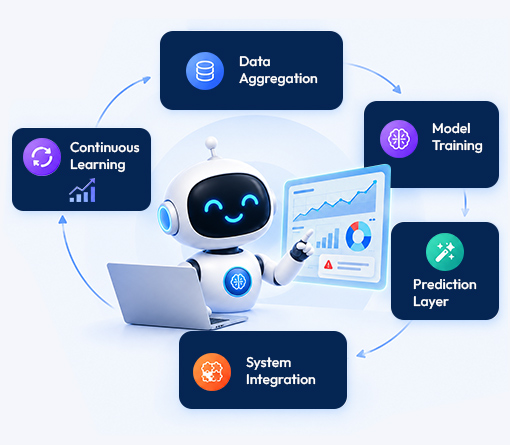
We build predictive models using your CRM, ERP, and operational data — to forecast churn, demand, revenue, and risks directly inside your existing systems.
Six specific pain points where AI delivers the fastest, most measurable return.
By the time a customer cancels, you've lost the window to intervene. Churn prediction models identify at-risk customers 30–60 days before they cancel — giving your CS team time to act.
Manual demand planning is backward-looking and slow. AI demand forecasting runs continuously — reacting to sales patterns, seasonality, and external signals weeks before they hit your warehouse.
Finance teams discover shortfalls in the last week of the quarter when it's too late to change anything. AI revenue forecasting gives a rolling 13-week view — updated daily, not monthly.
A pricing error, a traffic drop, a conversion rate collapse — discovered during the weekly review, not the moment it starts. AI anomaly detection flags deviations within hours, before they compound.
Campaigns targeted at current customers, not the customers most likely to convert next. Predictive lead scoring tells your marketing team which prospects are most ready to buy — right now.
Reactive maintenance is expensive and disruptive. Predictive maintenance models trained on sensor data identify failure signatures 24–72 hours before breakdown — scheduled during planned downtime.
Not vague AI promises. Specific systems, integrated with your existing tools, with ROI scoped before any development begins.
ML models trained on customer behavior, usage patterns, support history, and payment trends identify customers showing early churn signals — surfaced as a risk score in your CRM with the key drivers shown.
Rolling 30–90 day demand forecasts trained on your sales history, seasonality, external signals, and supply chain data. Auto-triggers purchase orders when stock is predicted to run low.
AI-powered rolling revenue forecast combining CRM pipeline, historical conversion rates, seasonality, and rep-level performance — more accurate than spreadsheet models, updated continuously.
Continuous monitoring of your key business metrics — conversion rate, revenue, support volume, system performance. Anomalies flagged with root cause analysis within hours of occurrence.
AI scoring models that rank leads and customers by likelihood to convert, expand, or churn — surfaced in your CRM so sales and CS teams focus their effort where it has the highest impact.
Beyond standard use cases — we build custom ML models for any prediction your business needs: fraud probability, maintenance windows, pricing optimization, capacity planning.
These are live systems we've built for clients. Specific scenarios, specific results.
ML model trained on your customer data — login frequency, feature usage, support tickets, payment behavior, contract stage — scores every customer with a churn probability updated daily. At-risk customers surfaced in CRM for CS team action.
Rolling demand forecasts trained on sales history, seasonal patterns, promotional calendar, and external signals. Automatically triggers purchase orders when predicted stock levels fall below safety thresholds.
Continuous monitoring of revenue, conversion, and pipeline metrics. Deviations from baseline flagged with root cause analysis and suggested actions — within hours of the anomaly beginning.
AI scoring model trained on your won/lost deal history — company size, industry, behavior signals, engagement patterns — scores every inbound lead and existing opportunity by close probability.
ML models trained on IoT sensor data — vibration, temperature, current draw, cycle anomalies — identify failure signatures before breakdown. Maintenance triggered during planned downtime windows, not emergency stoppages.
AI risk scoring trained on your portfolio data — payment history, exposure, sector risk, behavioural signals — scores customers continuously and surfaces deteriorating accounts before they become write-offs.
Every predictive model is trained on your specific historical data — your customers, your products, your patterns. Generic industry models give generic results. Yours gives accurate results for your situation.
Predictions appear in Zoho CRM, Salesforce, Power BI, or your custom dashboard — where your team already works. No new system to adopt, no new login to remember.
Every score comes with the drivers. "This customer has an 84% churn risk because: usage down 60%, support tickets up, last renewal was late." Your team understands why and knows what to do.
We calculate the expected business value of each predictive model before building it — deals saved, inventory cost reduced, failures prevented. You know the expected return before committing budget.
Every correct and incorrect prediction feeds back into the model. Accuracy typically improves from 78% at launch to 90%+ within 6 months. Models don't degrade — they get sharper.
All three include NDA before day one, ISO 27001 certified process, and ROI modelled before any development commitment.
Every engagement starts by understanding your specific situation — not by proposing technology. ROI is scoped before any code is written.
We map your current process, identify the top opportunities, and model the ROI — before any commitment.
Architecture, data flows, integration plan — reviewed and approved by your team before development starts.
Built into your existing stack via secure APIs. Tested against real data before go-live. Zero disruption.
Live with performance dashboards. As your needs grow, the solution scales — no additional resource required.
You're managing renewals reactively — finding out customers are unhappy when it's too late to fix it. Churn prediction gives your team a 30–60 day window to intervene before the decision is made.
Your revenue forecasts are spreadsheet-based, updated monthly, and frequently wrong. AI gives you a rolling 13-week forecast updated daily — with variance explained, not just a number.
You're managing inventory with historical averages and gut feel. AI demand forecasting reacts to real signals — order pipeline, seasonality, supplier lead times — weeks before they affect your warehouse.