Free AI Readiness Assessment — we map your automation opportunities in 60 minutes, no obligation.
🤖 AI Development
Free AI Feature Assessment
We assess your application, your data, and identify where AI adds real value — before any commitment.

🔒 ISO 27001 · NDA before any details shared · No spam

Add AI to Existing Apps

🤖 AI Engineering

Your Application Already
Has the Data.
Let's Make It Think.

We add intelligent features to existing applications — recommendation engines, invoice parsing, automated code generation, AI chatbots, and predictive suggestions — trained on your specific data, not generic models. We built custom MCU infrastructure to train proprietary AI for PrintPlanr and Element IQ without sharing sensitive data with third-party platforms.

AI FEATURES · PRINTPLANR · ACTIVE
● Models running
AI MODELS
6
Active in production
TRAINING
MCU
Own infrastructure
CHATBOT
Live
Self-service
PRINTPLANR AI FEATURES — ACTIVE
Press recommendation — optimal press per job spec
Live
Auto job code generation from description
Live
Product recommendation engine
Live
AI chatbot — customer self-service support
Live
ELEMENT IQ AI — IN PROGRESS
Automated job scheduling and dispatch
Dev
Invoice parsing — contract compliance before payment
Dev
CUSTOM MCU INFRASTRUCTURE — OWN TRAININGWe built our own MCU servers to train AI on client data. No data sent to third-party AI platforms. Models trained and owned entirely by the client.
MCU
Custom infrastructure built for proprietary AI model training — no data leaves your environment
6
AI features active in PrintPlanr — press recommendation, auto code, product suggestions, chatbot
Invoice
Parsing for Element IQ — validates against contract terms before payment, catches duplicates
Your
Data, your model — AI trained on your specific domain, not a generic model applied to your use case
🖥️

We built custom MCU server infrastructure to train proprietary AI models on client data

Most AI implementations wrap a third-party API (OpenAI, Google, etc.) around your application. That works for general tasks. It doesn't work when the AI needs to understand your specific domain — your products, your press types, your job specifications, your customers. For PrintPlanr, we built our own MCU (Model Compute Unit) infrastructure that trains AI models exclusively on PrintPlanr data. The model learns what makes a job specification match a specific press. What product a customer typically needs based on their requirements. How to generate accurate production codes from a simple job description. No sensitive client data leaves the environment. The model is owned by the client, not by a third-party AI platform.
✦ Custom MCU training infrastructure ✦ No data sent to third-party AI ✦ Domain-specific models ✦ Client owns the model
— When AI Adds Real Value

Six situations where adding AI to an existing application changes the outcome

AI adds value when it removes friction from a decision a human makes repeatedly — or when it processes information at a scale or speed that humans can't match.

🔍

Users search for things that could be recommended to them

A customer browses your product catalogue to find what they need. A recommendation engine surfaces what they need before they finish searching — based on their history, their requirements, and patterns from similar customers. PrintPlanr's product recommendation engine does exactly this.

📄

Documents processed manually could be parsed automatically

Invoices checked against contracts by hand. Purchase orders compared to agreed terms manually. This takes time and misses things. AI invoice parsing — as we're building for Element IQ — validates invoices against contract terms automatically, flags discrepancies, and catches duplicate charges before payment is processed.

💬

Support tickets answering the same questions repeatedly

A significant proportion of support tickets ask the same questions that are already answered in your documentation, knowledge base, or previous tickets. An AI chatbot trained on your specific product and support history answers these automatically — reducing ticket volume and freeing your support team for genuinely complex issues.

Repetitive data entry that follows predictable patterns

Production codes that follow rules based on job specifications. Job descriptions that use consistent language patterns. Form fields that are almost always populated the same way for similar job types. AI auto-generation and auto-suggestion removes the repetitive entry while keeping the human in control of the final decision.

🎯

Decisions that require matching requirements to options

Which press is optimal for this job's specifications? Which supplier is best for this order's requirements? Which resource should handle this job type? These matching decisions follow patterns that AI learns from historical data — and can apply in milliseconds at the point of decision.

📅

Scheduling that has complex constraints and dependencies

Job scheduling with multiple resources, varying job durations, deadline constraints, and competing priorities is difficult to optimise manually. AI scheduling — as we're building for Element IQ — factors in all constraints simultaneously and produces an optimised schedule that a human would take hours to calculate.


✦ Free · No Commitment

Want to know what AI could add to your specific application?

Free assessment — we look at your application, your data, and identify where AI adds real measurable value.
— AI Features

Six AI features we've built or are building for real applications

All reference the real work we've done on PrintPlanr, Element IQ, and other platforms.

🖨️
Recommendation Engine

Press Matching & Recommendation

Trained on historical print jobs, the model recommends the optimal press for each incoming job specification — factoring in paper type, quantity, colour requirements, finish, and deadline. Built for PrintPlanr.
PrintPlanr · Live
Auto-Generation

Production Code Generation

AI generates accurate production codes from a simple job description — removing manual code lookup and entry. Also provides auto-suggestions for job descriptions based on job type patterns. Built for PrintPlanr.
PrintPlanr · Live
🛍️
Recommendation Engine

Product Recommendation

Surfaces the right product based on customer requirements and order patterns — replacing manual catalogue browsing. Trained on product specifications and customer history. Built for PrintPlanr.
PrintPlanr · Live
💬
AI Chatbot

Customer Self-Service Chatbot

Trained on product documentation, support history, and FAQs — answers common support queries automatically, reducing ticket volume and freeing the support team for complex issues. Built for PrintPlanr.
PrintPlanr · Live
📄
Document Intelligence

Invoice Parsing & Contract Validation

Parses incoming invoices and validates line items against contract terms automatically — flagging discrepancies and catching duplicate charges before the invoice reaches approval. Being built for Element IQ.
Element IQ · In development
📅
Optimisation

Automated Job Scheduling

AI-optimised job and technician scheduling factoring in resource availability, job duration estimates, location, skill requirements, and priority constraints simultaneously. Being built for Element IQ.
Element IQ · In development

— In Depth

How we added AI to PrintPlanr — the full story

PrintPlanr is our most complete AI implementation to date. Here's exactly what we built, how, and why.

01

PrintPlanr — Custom MCU Infrastructure + Six AI Features on a Production SaaS Platform

+

PrintPlanr had years of production data — job specifications, press assignments, production outcomes, customer orders, product selections. That data was a training resource sitting unused. Rather than wrapping a generic third-party AI API around the platform, we built our own MCU (Model Compute Unit) server infrastructure to train models specifically on PrintPlanr's domain. The models understand print production in a way no general-purpose AI does — because they were trained exclusively on print production data.

💰Six AI features active in production · Custom MCU training — no data sent to third-party platforms · Models owned by the client · Chatbot reducing support ticket volume
// The six features and what they replaced
1. Press recommendation: replaced manual press selection by operators → AI recommends optimal press from job spec in seconds. 2. Auto production code generation: replaced manual lookup of production codes → AI generates from job description. 3. Job description auto-suggestions: reduces typing time, ensures consistent description format across operators. 4. Product recommendation: replaced manual catalogue browsing → surfaces the right product from customer requirements. 5. AI chatbot: answers common support questions automatically → reduces support ticket volume, frees team for complex queries. 6. MCU infrastructure: all models trained on PrintPlanr production data only — domain-specific accuracy that generic models can't match.
Custom MCU InfrastructureProprietary Model TrainingAI ChatbotRecommendation Engine
02

Element IQ — Invoice Parsing + Job Scheduling AI Being Added to a 20-Year-Old ERP

+

Element IQ is a mature field service ERP — 20+ years of production data, complex operations, enterprise clients. Adding AI to a system this established requires surgical precision — the AI must enhance workflows without disrupting the existing operations that enterprise clients depend on. We're adding two AI capabilities: invoice parsing to automate contract compliance checking before payment, and intelligent job scheduling to optimise resource allocation. Both address genuine operational pain that manual processes currently handle inefficiently.

💰Invoice parsing catches duplicate charges and contract violations before payment · Job scheduling optimises across resource availability, location, skill, and priority simultaneously
// Invoice parsing — the problem it solves
Field service businesses receive invoices from multiple suppliers, subcontractors, and parts vendors. Manual checking of each invoice against the contract terms that govern it is time-consuming and error-prone. Duplicate charges, rate discrepancies, and line items outside contract scope are all possibilities that manual review catches inconsistently. The AI parses each invoice, extracts line items, matches against the relevant contract in Element IQ, flags any discrepancies — rate higher than contracted, line item not covered by contract, possible duplicate from a previous invoice — and presents a validated summary before the invoice reaches the approval queue. Time saved, errors caught, overpayments prevented.
Invoice Parsing AIContract MatchingScheduling Optimisation.NET / Element IQ

— What AI on Your Application Delivers

Honest outcomes from real AI implementations

Real results from AI we've shipped

6
AI features active in PrintPlanr production — recommendation, auto-generation, chatbot — all trained on domain data
MCU
Custom infrastructure built for proprietary model training — data stays in your environment, model is yours
Support ticket volume reduced by PrintPlanr AI chatbot — self-service answers for common queries before agent involvement
Invoice
Parsing for Element IQ catches contract discrepancies automatically — before payment, not after

Domain-specific AI beats generic models

A general-purpose AI doesn't know that a 4-colour offset job on 150gsm coated stock should go to press 3 not press 1. A model trained on your production history does. Domain specificity is the difference between AI that helps and AI that gives plausible-sounding wrong answers.

We built our own training infrastructure — your data stays with you

We don't send your production data to OpenAI or any other third-party platform for training. We built MCU server infrastructure specifically to train models on client data in a controlled environment. The model is trained on your data, owned by you.

AI added surgically — existing workflows preserved

We add AI as an enhancement layer, not a replacement of existing functionality. Users can accept or override every AI suggestion. The system works without the AI if a model needs retraining. No workflow dependency on a single model.

23 years of application context — we understand the engineering constraints

Adding AI to a mature production system requires understanding how that system works deeply. We've been building and maintaining complex applications for 23 years. We know how to add AI without breaking what's already working.

— Engagement Models

Three ways to start

✦ Start here

Free AI Assessment

No cost · No obligation
60 minutes · Remote
  • Audit your application and available data
  • Identify where AI adds measurable value
  • Assess data quality for model training
  • Recommend the right AI approach
  • Written assessment yours to keep
🔄 Ongoing

AI Development Retainer

Monthly · Continuous AI development
Min. 3 months
  • Named AI engineer on your roadmap
  • New AI features added each sprint
  • Model retraining as new data accumulates
  • Performance monitoring and tuning
  • Priority support — same-day response
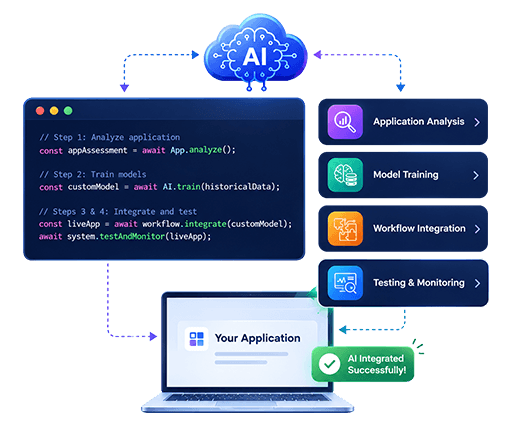
— How We Work

From data audit to live AI feature

Data quality assessed first. Model trained and validated second. Deployed surgically into your existing application third.

🔍
01 —

Data & Application Audit

We assess your historical data quality and volume, and map where in your application the AI feature integrates.

🧪
02 —

Train & Validate

Model trained on your domain data. Accuracy validated against holdout sets. Benchmarked against the current manual baseline.

⚙️
03 —

Integrate & Test

AI feature integrated into existing application. All existing workflows preserved. UAT with real users on real data.

📈
04 —

Monitor & Retrain

Model performance monitored. Accuracy tracked against actuals. Retraining scheduled as new data accumulates.

— FAQ

Questions we always get about adding AI to applications

Why build custom AI instead of using OpenAI or another API?

+
For general tasks — summarising text, answering general questions, generating generic content — third-party APIs work well. For domain-specific tasks — recommending which press to use for a specific print job, generating production codes that follow your company's specific coding rules, validating invoices against your specific contract templates — general models give you generic-quality results. A model trained on your production history, your products, your contracts understands the domain. That's the difference between a recommendation that's probably right and one that's specifically accurate for your operations. We use third-party APIs where they're the right fit, and build custom models where domain specificity matters.

What data do we need to train a custom model?

+
It depends on the model type. For recommendation engines, we typically need historical records of what was selected/purchased alongside the context that led to that selection — usually several thousand records minimum for useful accuracy. For document parsing, we need examples of the documents to be parsed alongside their correct outputs — can be hundreds of labelled examples. For scheduling optimisation, historical job and resource data showing actual outcomes. We audit your data in the free assessment and tell you honestly whether you have enough, and what quality issues need addressing before training. We don't promise accuracy before we've seen the data.

What is MCU infrastructure and why did you build it?

+
MCU (Model Compute Unit) refers to the compute infrastructure we built specifically for training AI models. We built it because sending client production data to third-party training environments creates data security and IP concerns — particularly for clients in regulated industries or with sensitive operational data. Our MCU infrastructure allows us to train models in a controlled environment where client data doesn't leave the system boundary. The resulting model is owned by the client, runs on infrastructure we control, and isn't shared with or dependent on any third-party AI platform.

Can AI be added to an application built by a different team?

+
Yes — and we've done it. The AI feature integrates via API or direct integration with your application's data layer, regardless of what stack the application is built on. What matters is access to the relevant data for training, and a clear integration point in the application where the AI output surfaces. We've integrated AI features into applications built on .NET, Laravel, Python, and others. We assess the integration approach in the scoping phase — it rarely requires significant changes to the host application.

Ready to make your existing application significantly smarter?

Start with a free AI assessment. We look at your application, your data, and identify where AI adds real measurable value — before any commitment. 23 years of engineering, custom MCU training infrastructure, ISO 27001.

See all development services
— Related Services
🏗️
Build New Applications
Start from scratch
🔧
Rescue & Modernise
Fix what's broken
🤖
AI Automation Services
Broader AI capability
🔮
Predictive Analytics
ML on your business data
🏠
All Dev Services
Custom application overview
📊 BI Practice
Free Assessment
We find out why your dashboards aren't being used — and fix it.

🔒 ISO 27001 · No spam · Honest assessment