A client's website chatbot was costing them leads every day — visitors bounced before a human agent was free. We replaced the whole thing with Zoho SalesIQ powered by Claude AI. It never sleeps, never drops a contact, and answers real questions in real time.
The client had a chatbot. On paper it worked. In practice, it was a polite dead end — visitors picked from a menu of preset options, hit a wall, asked for a human, and then waited. Most didn't wait long.
Menu-based conversations with no flexibility. Visitors could only select from a handful of preset responses. Anything outside that list produced a dead end, not an answer.
Almost every session escalated to a human agent. Because the bot couldn't handle real questions, visitors immediately asked for a live person — putting the entire burden back on the support team.
Agents weren't always online. Outside business hours and during busy periods, visitors were left waiting. Most left before anyone responded.
Potential customers were walking out the door. By the time a human agent became available, the visitor had already moved on — and the lead was gone.
No contact information captured before exit. If a visitor left mid-conversation, there was no name, no email, no phone number. The sales team had nothing to follow up with — the conversation simply disappeared.
The chatbot wasn't failing because of bad implementation — it was failing because it was the wrong kind of chatbot. Menu-driven bots were a reasonable solution in 2018. By the time this project reached us, the gap between what visitors expected from a conversation and what a predefined script could deliver had become impossible to paper over.
We kept Zoho SalesIQ as the customer-facing chat platform — it handles the live chat layer, visitor tracking, and CRM handoff. What we replaced was the intelligence behind it. Claude AI (Anthropic) became the engine powering every conversation.
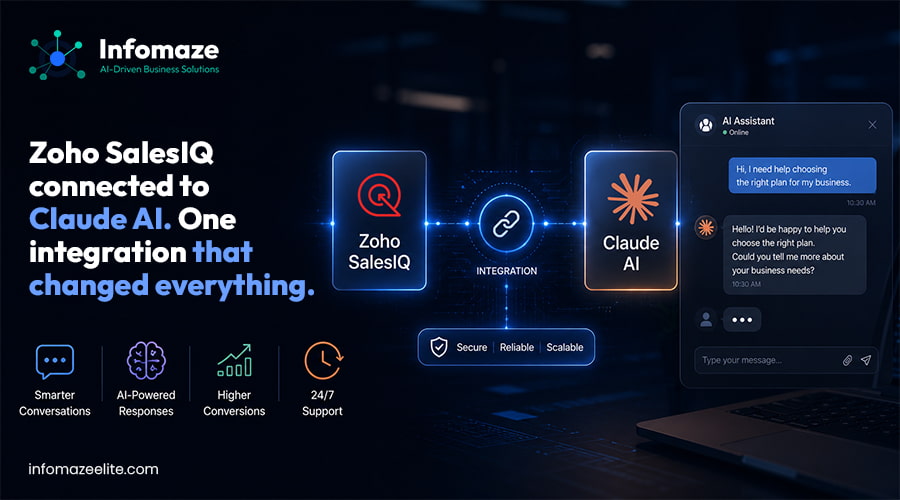
The rigid, menu-based interaction model was removed entirely. Claude AI handles every incoming message as a genuine conversational exchange — understanding intent, asking follow-up questions, and responding in natural language rather than presenting a list of buttons to click.
We built a comprehensive knowledge layer from the client's business information, service descriptions, FAQs, pricing structures, and common objections. Claude draws on this to answer specific questions accurately — not with generic replies, but with information that actually matches the client's offering.
Lead collection was redesigned as a natural part of the conversation, not a form slapped at the end. The AI is instructed to collect name, email address, phone number, and service requirements early in the exchange — conversationally, in a way that doesn't feel like a data harvest.
One of the biggest changes: any contact information collected — even just an email — is written to the CRM immediately. If a visitor exits mid-conversation, that lead doesn't vanish. The sales team gets a notification and a follow-up task regardless of whether the conversation reached a conclusion.
The AI handles the vast majority of incoming queries independently. Conversations that genuinely require a human — complex commercial discussions, sensitive complaints, specific account issues — are escalated with full context, so the agent picks up mid-conversation without asking the visitor to start over.
Claude was trained specifically on the client's services, FAQs, pricing, and common queries — so it answers as a knowledgeable representative, not a generic assistant. Visitors get accurate, specific answers on the first response.
The integration uses Zoho SalesIQ's bot API and webhook framework to route incoming messages to Claude and return responses in real time. The visitor experience is a single, uninterrupted conversation — the AI handoff is invisible.
Rather than gating the conversation behind a form, lead information is gathered naturally as the AI engages — making the process feel conversational rather than extractive. Completion rates improve because visitors don't feel interrogated.
No queue. No waiting for an agent to come online. Every visitor gets an immediate, intelligent response — at 2pm on a Tuesday or 2am on a Sunday. Response time went from minutes (or hours) to under a second.
The numbers below reflect the qualitative and operational shifts the client observed after replacing the menu-based chatbot with the AI-powered Zoho SalesIQ + Claude integration.
A chatbot that can only respond to what it was programmed to expect is only useful when visitors ask exactly the right questions in exactly the right way. That almost never happens. Replacing the fixed script with a trained AI model doesn't just improve the conversation — it changes what the chatbot is capable of doing for the business entirely.
Most chatbot projects start and end with the interface. Pick a platform, configure some responses, set it live. The problem is that conversation isn't configurable — it's generative. Every visitor has a slightly different version of the same question, and no decision tree covers all of them.
Zoho SalesIQ handles what it's genuinely good at — visitor tracking, chat UI, CRM integration, agent routing. Claude AI handles what it's genuinely good at — understanding and responding to natural language. Neither was asked to do the other's job.
Generic LLMs give generic answers. The difference was grounding Claude in the client's specific knowledge base — services, pricing, FAQs, and common objection patterns. The AI responded as if it had been briefed by the client team, not pulled from the open web.
Asking "can I get your email?" mid-conversation feels natural. Presenting a form before allowing access to answers feels like a toll booth. The conversational approach produced higher completion rates because it matched how people actually prefer to interact online.
The Zoho SalesIQ + Claude AI architecture is replicable for any business where the chatbot's current job is to filter visitors into human agent queues. If that queue is a bottleneck, the AI layer removes the bottleneck without removing the human — it just pushes human involvement to the conversations that genuinely require it. That's a different philosophy from automation for its own sake. It's automation that improves the quality of every human interaction by reducing the volume of routine ones.
These are the questions we get most often from businesses considering a similar implementation.
The chatbot now qualifies prospects, answers complex business questions in real time, and captures lead information 24 hours a day — without requiring a human agent to be online. Every partial conversation produces a CRM record. Every full conversation produces a qualified lead.
Discuss a similar project →