AI Agents vs Chatbots: Which One Is Right for Your Business?
Is your business ready to scale customer interactions, automate internal workflows, or improve response times but you are unsure whether to choose an AI chatbot or an AI agent?
Automation has become a cornerstone for businesses aiming to stay competitive. But while both AI chatbots and AI agents promise efficiency, scalability and smarter interactions, they serve very different purposes.
Choosing between them is not just about technology but about selecting the right solution that aligns with your operational goals, customer experience strategy, and future growth plans.
In this blog we will explore the AI agents vs chatbots, providing clarity on capabilities, differences and practical business applications in 2025.
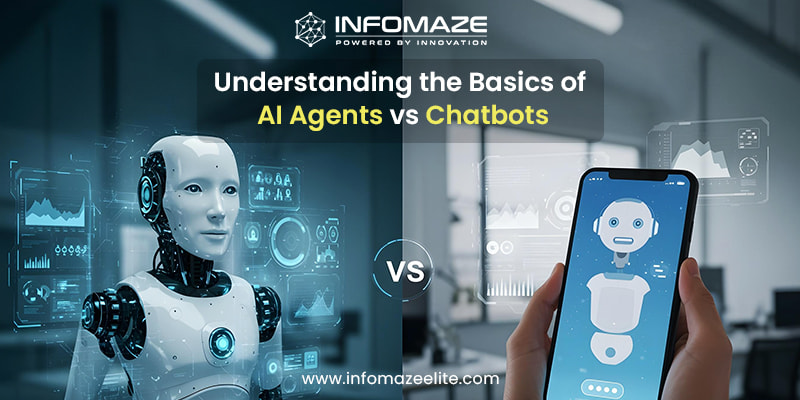
Understanding the Basics of AI Agents vs Chatbots
To evaluate chatbot vs AI assistant, it is important to first define each.
An AI chatbot is usually a rule-based or language model-driven conversational tool that responds to user inputs. It’s designed to handle basic, repetitive queries such as FAQs, appointment booking or order tracking.
In contrast, AI agents for business go beyond surface-level interactions. They simulate intelligent behavior and can autonomously perform tasks, make decisions, access multiple data sources and learn from interactions over time.
While both technologies use artificial intelligence, the underlying logic, scope and autonomy differ significantly.
What Are AI Chatbots?
AI chatbots are widely used in customer-facing industries. Whether you are ordering pizza, checking your bank balance, or asking about shipping delays, there is likely a chatbot powering that experience. These bots are programmed to follow scripts or use Natural Language Processing (NLP) to understand and reply to specific inputs.
They are best suited for structured and predictable interactions. For example, an AI chatbot for customer service can help route tickets, provide step-by-step troubleshooting or notify customers of account changes. Chatbots are quick to implement, cost-effective and relatively easy to maintain which make them a go-to for businesses that need a responsive, always-on interface.
However, their capabilities are limited when users deviate from expected questions, or when the problem involves multiple steps or requires contextual memory. They lack true reasoning and adaptability.
What Are AI Agents?
AI virtual agents, on the other hand, are built for complexity. They represent a new generation of intelligent automation tools that simulate human-like reasoning, decision-making, and learning. They can carry out multi-step tasks, fetch and analyze data from multiple sources and adapt their actions based on prior outcomes or real-time context.
For instance, an AI agent in an e-commerce company can analyze customer behavior, initiate a personalized product recommendation flow, handle returns and update inventory systems and all autonomously. Where chatbots react, AI agents act proactively.
One of the major advantages of using AI agents for business is their ability to integrate with backend systems like CRMs, ERPs, and data warehouses, making them ideal for both customer service and internal operations like HR, finance and logistics.
In 2025, many organizations are investing in AI automation for businesses by deploying agents as digital co-workers who reduce workload, assist in decision-making and ensure accuracy at scale.
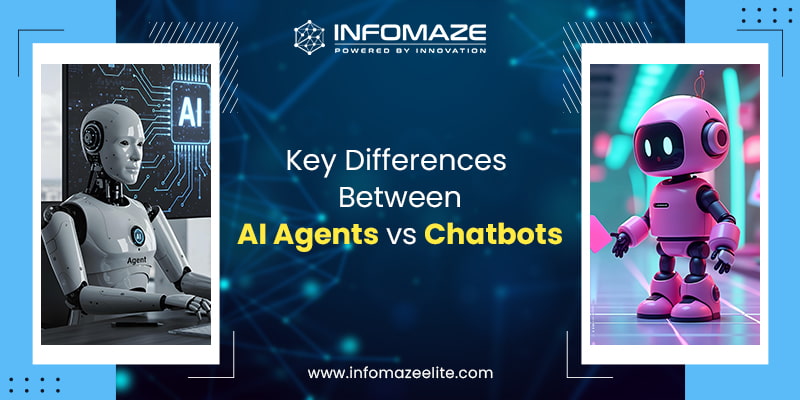
Key Differences Between AI Agents vs Chatbots
To truly understand the AI agents vs chatbots divide, consider several key areas where their functionality diverges:
Autonomy and Complexity
Chatbots typically operate on user input—they answer questions or follow predefined flows. They rely heavily on templates and aren’t capable of decision-making. In contrast, AI agents act autonomously, performing tasks without requiring human prompts. They handle workflows, make context-aware decisions, and even initiate conversations when needed.
Learning and Adaptability
AI chatbots may have some learning ability through machine learning but it is usually limited to improving responses to repeated questions. AI virtual agents, however, continually evolve. They learn from data, feedback and outcomes, refining their approach over time to become smarter and more efficient.
Integration Capabilities
Chatbots are usually front-end tools. They may pull limited data from a database or CRM but that is often the extent of their integration. AI agents for business integrate across the full tech stack—cloud platforms, APIs, internal systems which allow them to function as intelligent process owners.
Use Cases
An AI chatbot for customer service is great for answering “What’s my order status?” but an AI agent can process a refund, check inventory, notify the customer and update the system—all in one seamless operation. The latter offers greater value in terms of end-to-end task completion.
When Should You Choose AI Chatbots?
Chatbots are ideal for businesses that:
- Receive high volumes of similar, repetitive queries
- Need a quick-to-deploy conversational interface
- Have limited backend system complexity
- Want to reduce human support load with a budget-friendly tool
They are particularly effective for e-commerce, travel, education, and SaaS platforms that require immediate responses and 24/7 customer engagement.
If you are exploring basic AI automation for businesses and have structured workflows, a chatbot can serve as a cost-effective starting point.
When Are AI Agents the Better Choice?
If your business requires more than answering FAQ such as managing transactions, verifying data across systems, initiating follow-ups or making recommendations then AI agents for business are the better fit. They are excellent for:
- Complex customer service tasks involving multiple systems
- Internal automation (e.g., employee onboarding, invoice processing)
- Personalized and proactive customer engagement
- Scenarios where reasoning and decision-making are essential
As digital work becomes more sophisticated, AI agents are becoming digital teammates, not just tools.
Combining Both With The Hybrid Approach
In many cases, the best strategy is not chatbot vs AI assistant but a combined deployment. Businesses can use chatbots for surface-level interactions and route complex issues to AI agents. This layered approach balances cost, complexity, and user experience.
For instance, a chatbot might greet a user, ask for account details, and identify intent. Once it detects a refund request or service escalation, it hands off the conversation to an AI agent that takes over the process, retrieves historical data, applies return policies, and completes the transaction.
This synergy improves workflow continuity, reduces errors, and enhances customer satisfaction, all while optimizing backend operations.
The Future of AI Automation for Businesses
The conversation around AI agents vs chatbots reflects a larger trend: the evolution from reactive systems to proactive digital intelligence. Businesses that embrace AI at multiple levels including simple and advanced will gain a competitive edge through faster resolution, deeper personalization and smarter decision-making.
With continued improvements in NLP, machine reasoning and integration APIs, AI virtual agents will become increasingly autonomous and reliable. Meanwhile, chatbots will grow more intelligent but will still remain limited to front-line interactions unless paired with backend intelligence.
Final Thoughts
The decision between AI chatbots and AI agents should be based on your business’s complexity, integration needs, and long-term digital transformation goals. While chatbots offer an accessible and fast entry point into automation, AI agents for business bring the depth, intelligence, and adaptability needed for more complex workflows and scalable innovation.
Infomaze specializes in building intelligent automation frameworks tailored to your needs whether it is deploying powerful AI chatbots for customer service, integrating AI virtual agents for complex operations, or creating a seamless hybrid system.
Categories
- AI & Automation (2)
- Application Migration (8)
- Articles (6)
- BI (9)
- Case Study (55)
- CRM (8)
- Custom Applications (5)
- Dot Net (8)
- ERP & CRM (4)
- Guide (5)
- Informational Blog (77)
- IT Help Desk (8)
- Mern Stack (4)
- Microsoft 365 (2)
- Mobile Application (9)
- Offshore Development (10)
- Outsourcing Services (1)
- Perspective (4)
- PHP (10)
- PowerBI (7)
- QuickBooks (6)
- ReactJS (4)
- SEO (14)
- SharePoint (3)
- Uncategorized (8)
- Web Application (10)
- Xero (1)
- Zoho (16)
- Zoho Case Study (41)