From Fragmented Data to Intelligent Systems: AI Data Enrichment Case Study
Data is only as valuable as its reliability. Yet in many enterprises, critical information remains siloed, unstructured, duplicated, or even incomplete. All this results in slow decisions, inconsistent reporting and broken automation.
This case study highlights how our AI-powered data enrichment services transformed fragmented datasets into a unified, high-fidelity intelligence ecosystem. Through advanced enterprise data enrichment architecture, we enabled seamless interoperability between CRM, ERP, and internal systems. This transforms dormant data into an operational asset for our client.

Client Overview
Our client is a leading enterprise operating at high data velocity, managing millions of records across legacy SQL-based ERPs and cloud-native NoSQL CRMs.
However, high growth introduced structural inconsistencies and data decay. Schema mismatches, duplication and manual validation loops began impacting automation and insight generation. They required scalable data enrichment solutions that could handle complex integrations, improve data completeness, and support intelligent workflows across departments.
The need was clear to deploy AI data enrichment services that ensure reliability and performance across systems.
Challenges in Enterprise Data Fragmentation & Quality Management
Modern enterprises face “data rot”, which is a silent degradation of value over time. Our client experienced this firsthand. Below are the six primary blockers, described in their own operational reality:
Heterogeneous Schema Inconsistency
Our client was facing significant structural inconsistencies between their SQL-based legacy ERP systems and NoSQL CRM platforms. During synchronization, datatype conflicts, metadata loss, and field truncation frequently occurred, disrupting workflows and compromising reporting accuracy.
High-Latency Manual Verification Loops
The organization relied heavily on manual validation processes to verify incoming data. This dependency created high-latency verification cycles, resulting in stale data reaching production environments and slowing down operational decision-making.
Data Incompleteness & Feature Gaps
Their internal datasets lacked critical external enrichment signals such as firmographic and technographic attributes. This data sparsity weakened analytical models, reduced segmentation accuracy, and limited the effectiveness of their B2B data enrichment initiatives.
Entity Resolution & Identity Ambiguity
The client’s exact-match logic was insufficient to reconcile inconsistent naming conventions across systems. This led to duplicate entities, fragmented reporting outputs, and reduced data reliability across integrated platforms.
Unstructured Data Entrapment
A substantial volume of critical business information remained locked in PDFs, scanned documents and OCR outputs. Without any structured extraction mechanisms, this data could not be ingested into queryable pipelines or leveraged for automation.
Semantic Inconsistency & Normalization Failure
The absence of a unified data model caused naming variations, regional format mismatches and inconsistent attribute definitions across departments. This lack of normalization increased data noise and reduced orchestration reliability.
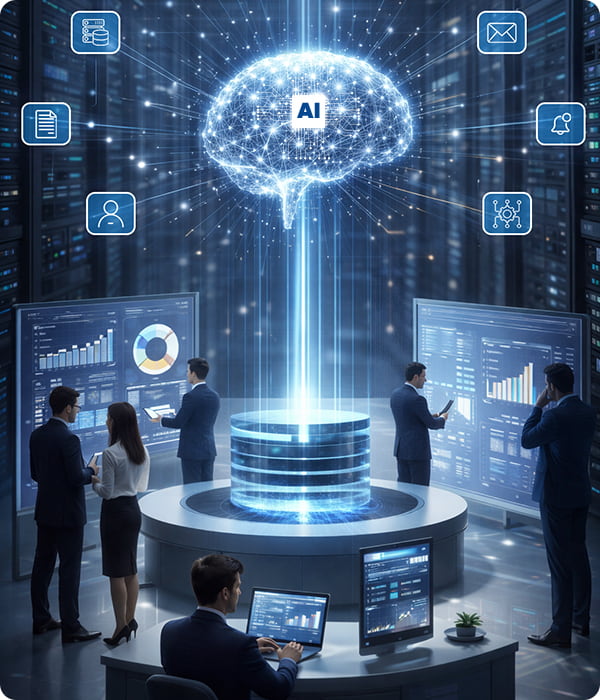
AI-Powered Data Enrichment Solutions for Enterprise Systems
To address these challenges, we architected a scalable enrichment engine powered by enterprise data enrichment principles and intelligent automation.
We built an automated extraction layer to convert unstructured documents into structured, machine-readable datasets. This forms the foundation of automated data enrichment.
- NLP-based entity and contextual extraction
- OCR processing for scanned files and PDFs
- Automated schema mapping to internal databases
- Event-driven real-time ingestion workflows
This significantly improved CRM data enrichment, which further ingested previously inaccessible business-critical information.
We implemented a probabilistic matching engine to unify duplicate records across systems.
Core Components:
- Fuzzy matching via similarity algorithms
- Multi-attribute confidence scoring
- Rule-based golden record creation
- Automated record merging workflows
This advanced layer of customer data enhancement ensured consistent reporting, reduced fragmentation, and improved data trustworthiness across the enterprise.
To resolve incomplete records, we designed predictive enrichment pipelines powered by external intelligence sources and ML inference.
Architecture Highlights:
- Asynchronous REST API orchestration
- Automated external enrichment workflows
- ML-based missing attribute prediction
- Scheduled dataset refresh pipelines
Through integration with a robust company data enrichment API, the system continuously enriched records with real-time intelligence. This strengthened B2B data enrichment and improved sales and marketing alignment.
We created a normalization layer to align heterogeneous schemas across platforms.
Standardization Mechanisms:
- Cross-system schema transformation
- Standardized naming conventions and formats
- Automated datatype validation rules
- Unified enterprise data model enforcement
This ensured long-term sustainability of enterprise data enrichment and also eliminates schema drift and reducing orchestration failures.
To ensure governance and accuracy, we deployed automated quality validation mechanisms.
Quality Assurance Features:
- AI-driven anomaly detection
- Rule-based validation checks
- Data quality scoring models
- Continuous monitoring and real-time alerts
This strengthened CRM data enrichment pipelines and ensured enriched datasets remained accurate and compliant.
Why AI Data Enrichment Matters for Enterprise Decision Makers
Enterprise leaders require speed, accuracy, and scalability. Here’s how strategic data enrichment solutions impact stakeholders:
For CTOs: Scalability & Technical Efficiency
Modular Data Pipelines:
Transitioned from rigid scripts to scalable microservices-based pipelines.
Engineering Optimization:
Reduced manual effort through intelligent automation and validation layers.
Cloud-Native Scalability:
Enabled horizontal scaling under high-volume data velocity environments.
System Interoperability:
Improved cross-platform compatibility between ERP, CRM, and internal systems.
For CEOs: Business ROI & Competitive Advantage
Faster Insight Generation:
Converted raw records into actionable intelligence rapidly.
Operational Cost Reduction:
Eliminated manual audits through automated workflows.
Improved Reporting Accuracy:
Enhanced data consistency across executive dashboards.
Market Advantage:
Leveraged high-fidelity data intelligence for strategic growth initiatives.
Strategic enterprise data enrichment transforms data infrastructure into a business growth engine.

Results and Business Impact
The integration of intelligent data enrichment solutions positioned the client for long-term digital scalability.
99% Key-Field Density
Improvement in CRM data enrichment completeness.
Thousands of Duplicates Resolved
Automated deduplication reduces manual audit workload.
Higher Sales Pipeline Throughput
Improved processing speed with significantly fewer errors.
Faster Validation Cycles
Reduced latency enabling quicker production updates.
Improved Enrichment Accuracy
B2B enrichment enhanced using external intelligence signals.
Conclusion
AI-driven data enrichment is a foundational infrastructure transformation. By deploying AI-driven pipelines, this enterprise-grade client converted fragmented, unreliable data into a high-performance intelligence ecosystem.
Through scalable AI data enrichment services, robust enterprise data enrichment architecture, and advanced automated data enrichment frameworks, Infomaze turned data from a liability into a strategic asset.
Today, their systems remain agile, interoperable, and ready for the next wave of growth, powered by our intelligent, continuously optimized data.
Do you have a use case like this one?
Let us know! Our product experts can configure the best solution for your business.