Most agencies didn't set out to become software companies. A design shop starts fielding requests for a client portal. A marketing agency's best client wants a lead-scoring workflow, not just a campaign. A branding studio gets asked for an app, not a logo. None of this shows up in the original business plan, and none of it is optional to say no to — not without watching that client find someone else who says yes.
This is the quiet pressure behind most agencies' interest in white label development: not a lack of ambition, but a mismatch between how fast client expectations are expanding and how fast any agency can responsibly hire for every one of those skills in-house.
- Agencies use white label development to say yes to web, app, and AI projects they don't have in-house engineering for — without the cost, delay, or risk of hiring a full team.
- The partner builds under the agency's brand and NDA; the client only ever sees the agency.
- It works best for scope beyond the agency's core skill set, overflow during hiring gaps, and specialised work like AI, ERP, or platform integrations that aren't worth building a permanent team around.
What "white label" actually means in a development partnership
The term gets used loosely, so it's worth being precise. In a white label development arrangement, a development team builds the work — code, testing, deployment, sometimes ongoing support — but the client relationship, the brand, the invoice, and the credit belong entirely to the agency. The development partner works under NDA, doesn't appear in any client communication, and often doesn't even know the end client's name unless the agency chooses to share it.
This is different from typical freelance outsourcing or a staffing marketplace, where the agency is really just a broker introducing a contractor to a client. A proper white label partner behaves like an internal team that happens to sit outside the building: same project management discipline, same documentation standards, same accountability for deadlines — just without the payroll, the recruiting cycle, or the bench cost between projects.
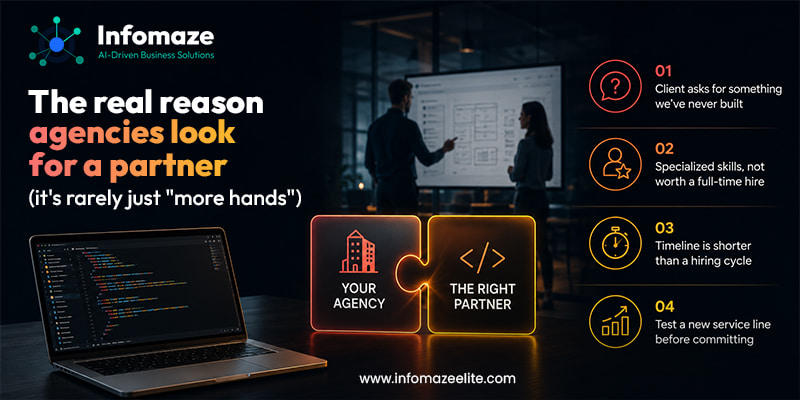
Overflow capacity is the reason most people assume, and it does happen — a busy quarter, a team member out, a deadline that can't move. But in practice, the more common trigger is a capability gap, not a capacity gap.
A client asks for something the agency has never built:
An AI chatbot, a Zoho-integrated internal tool, a mobile app — work that's a one-off for this agency, not a repeatable service line worth hiring a permanent specialist for.
The work needs a skill set that doesn't justify a full-time hire:
Nobody wants to hire a senior ERP developer for one project, then have them sit idle for the next six months.
The timeline is shorter than a hiring cycle:
A client wants to start in two weeks; recruiting a qualified developer realistically takes six to ten.
The agency wants to test a new service line before committing to it:
Offering "AI automation" or "custom app development" on the website is low-risk if a white label partner is quietly doing the delivery while the agency builds a track record.
The math agencies are actually running
Hiring a senior developer in the US or UK typically runs somewhere in the $70,000–$120,000 base salary range before benefits, equipment, software licensing, and management overhead are added — and those extras commonly add another 25–35% on top of the base number. That's before accounting for the ramp-up time a new hire needs, or the risk of a bad hire on a specialised skill the agency can't properly evaluate in an interview.
It's also worth noting how the reasoning behind outsourcing has shifted. Deloitte's outsourcing research has tracked a steady decline in cost as the primary driver — from roughly 70% of buyers citing cost as their top reason a few years ago to closer to a third today — with the balance shifting toward access to specialised expertise and faster time-to-market. In other words, agencies aren't reaching for white label partners because they're cheap. They're reaching for them because building certain capabilities in-house doesn't make sense at agency scale, regardless of price.
The agencies that struggle with white label partnerships almost never struggle because the model is flawed. They struggle because they picked a vendor, not a partner.
Not every development shop that offers "white label services" operates the same way, and the difference matters more than the price sheet. Before signing anything, agencies are generally better served checking for the following:
- A real NDA and non-solicitation agreement — in writing, covering both the client relationship and the agency's own IP, not a verbal assurance.
- No branding anywhere in the deliverable. No footer credits, no code comments with the vendor's name, no emails that accidentally cc the wrong domain.
- A single, reliable point of contact — not a rotating cast of developers the agency has to re-brief every sprint.
- Documentation and process maturity, evidenced by certifications like ISO 9001 or ISO 27001 rather than just claimed on a homepage.
- Flexibility to scale up or down project by project, without minimum monthly commitments that punish an agency for a slow quarter.
- Direct access to the people doing the work, not just a sales layer, when something needs to move fast.
The failure mode agencies describe most often isn't quality. It's communication breakdown: a partner that's hard to reach mid-sprint, updates that arrive late or vague, or a handoff that leaves the agency explaining technical details to a client it doesn't fully understand itself.
The fix isn't a better contract — it's a better process:
Weekly (or more frequent) structured updates, a shared project tracker the agency can see into at any time, and a partner that writes documentation the agency's own team could pick up if needed.
The second most common issue is scope creep silently becoming the agency's problem:
A clear, itemised scope of work with defined change-request pricing up front prevents this from turning into a margin-eating argument three weeks into a project.
When to build in-house instead
White label development isn't the right call for every situation, and a partner worth working with will say so. In-house hiring tends to make more sense when a capability is becoming a genuine, repeatable revenue line for the agency — not a one-off request — and when the agency has (or is ready to build) the technical leadership to manage that team properly. If a service is going to be sold to ten clients a year, every year, it's probably worth owning. If it's going to come up twice, a partner is the lower-risk, lower-cost path.
Considering a white label development partner?
We work behind the scenes for marketing, branding, and consulting agencies — building web, app, AI, and Zoho projects entirely under your brand, backed by ISO 9001 and ISO 27001 certified process. No client contact, no branding, no minimum commitment.