Hire a forward deployed engineer, or engage a partner who delivers in that same embedded model, when a standard software product or implementation approach cannot adequately solve your problem because your data, workflow, or systems are too specific for a generic approach. If your problem can be solved through configuration or a standard implementation path, a dedicated FDE may not be necessary.
Most businesses don't need to add "forward deployed engineer" to an org chart. But many businesses encounter the kind of situation the role is designed to address: a vendor's standard implementation team reaches the limits of its assumptions, and the resulting implementation has to be narrowed, reworked, or handed back to a standard support process. Below are the signals that may indicate you're in that situation, and what to consider next.
5 Signs Your Business Needs a Forward Deployed Engineer
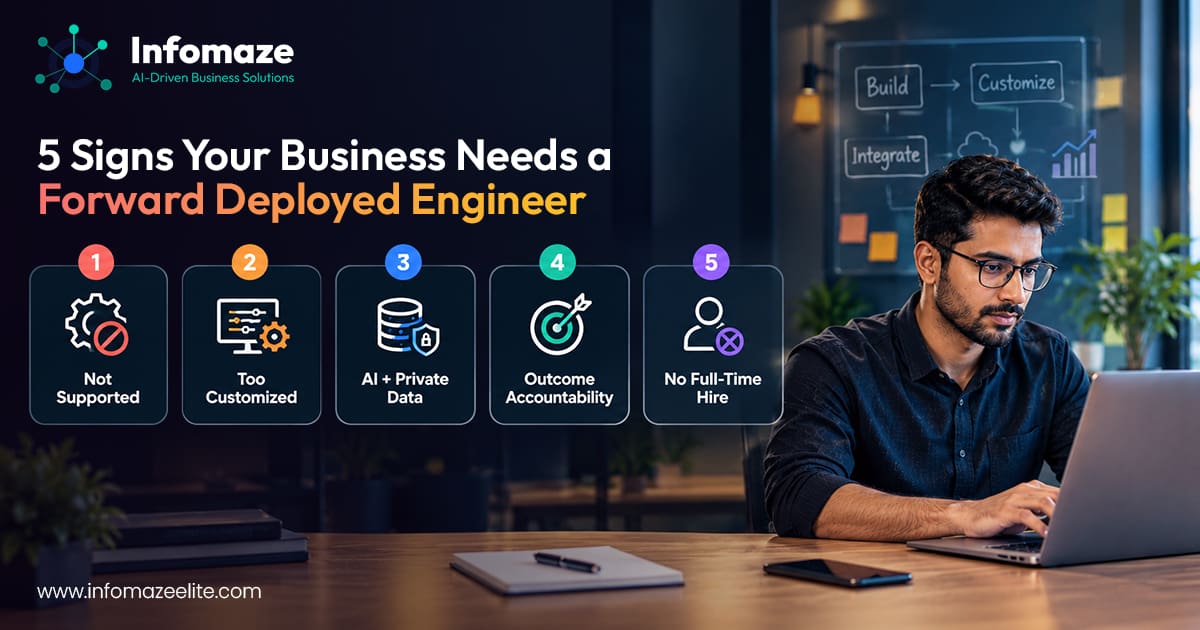
A standard implementation team has already told you "that's not really supported"
This can be a strong signal. If a vendor's implementation team has already looked at your systems and either declined the project or scoped it down to something that no longer solves your actual problem, it may indicate that a standard delivery model isn't a good fit for the requirements.
Your systems are too specific for off-the-shelf software to fit cleanly
Many businesses accumulate enough custom processes, legacy data structures, or industry-specific requirements that generic software eventually needs additional engineering work to bridge the gap. This isn't a failure on your part — it's what happens as a business matures past what a generic tool was built for.
You're trying to deploy AI against your own private data, not a generic demo
This is the newest and fastest-growing version of the problem. A generic LLM chatbot is easy to demo. Getting that same AI to answer accurately and safely from your actual documents, your actual customer data, and your actual internal systems is an entirely different engineering problem — exactly the gap forward deployed engineering was built to close in AI companies.
Not sure whether your situation actually needs embedded engineering?
Tell us what's not working with your current systems or AI pilot, and we'll give you an honest read on whether it's a configuration fix or a real custom build — no pitch deck, no obligation.
You need someone accountable for the outcome, not just a deliverable
Some engagements can fall short even when the agreed deliverables are completed, because the underlying business problem remains. In those situations, it can help to use a delivery model that considers real-world adoption and outcomes alongside the agreed scope and deliverables.
The volume of this kind of work doesn't justify a full-time hire
This can be a signal to consider a partner rather than an in-house FDE. If you genuinely need this kind of embedded, custom engineering work continuously, an internal hire may make sense. If the need is project-based — such as a legacy integration, AI deployment, or one-off custom build — engaging external engineering capacity may avoid carrying a full-time role between projects.
When an FDE is the wrong answer
You probably need an FDE (or partner) if..
- A standard implementation has already failed or been scoped down
- Your systems or data are genuinely non-standard
- You're deploying AI against private data, not a demo
- Past vendors delivered "to spec" but the problem persists
You probably don't need one if...
- The issue is a configuration or training gap, not a software gap
- A standard SaaS product already fits your workflow closely
- You haven't yet tried a standard implementation path
- The work is genuinely ongoing, high-volume, and justifies a full internal team
The businesses that get the most value from this model aren't the ones with the most complicated systems — they're the ones who stop trying to force a generic tool to do a specific job, and get someone to build the specific fix instead.
Hiring in-house vs. engaging a partner
If you've concluded you genuinely need this kind of engineering, the next decision is whether to build the capability internally or bring in a partner for the engagement. Standing up an internal forward deployed engineering function means recruiting for a mix of engineering, domain, and customer-facing skills and integrating that role into your existing organization. For a defined engagement — a legacy system migration, a custom application build, or an AI deployment against sensitive data — a development partner that works in a similar embedded model can provide that delivery capacity without adding a permanent role. That's the model we use across custom software development and AI workflow automation engagements at Infomaze.
Get the FDE outcome without the internal hiring cycle
We work closely with client teams, build against real systems and data, and stay involved through delivery — applying many of the same principles associated with the forward deployed engineering model without requiring you to add a permanent role.