Becoming a forward deployed engineer means building strong software engineering fundamentals, then deliberately gaining experience working directly with clients or end users on real, ambiguous problems. Many FDE candidates come from software engineering backgrounds, sometimes with experience in customer-facing engineering, implementation, or consulting roles that demonstrates they can handle both the code and the client relationship.
Job postings for forward deployed engineers can be misleading if you read them literally - they'll list a long, intimidating combination of deep technical skill and polished client-facing ability, as if both need to be fully formed before you apply. In practice, hiring managers are looking for a trajectory: solid engineering fundamentals, real evidence you can operate independently in front of a client, and the judgment to know when to build something quickly versus when to slow down and understand the problem better.
The path, step by step
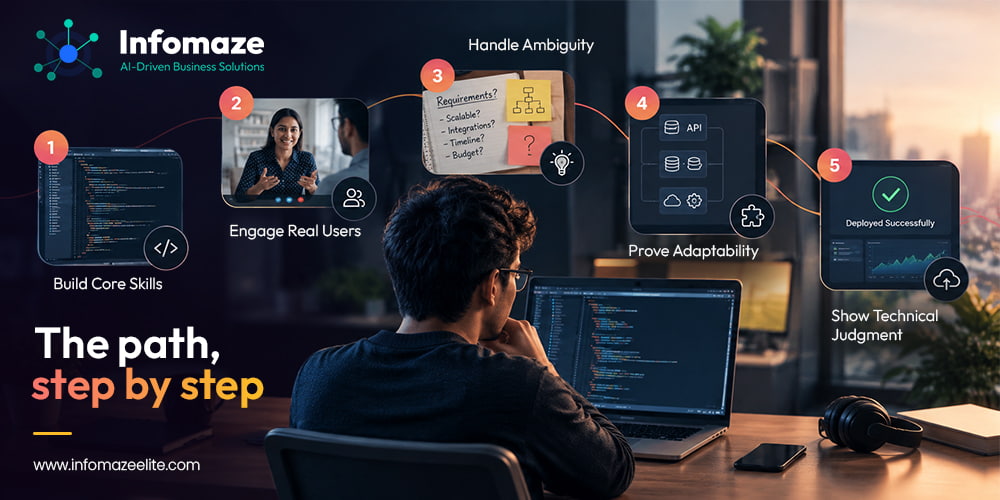
Build real software engineering fundamentals
Strong software engineering fundamentals are essential. Early in your career, focus on becoming genuinely capable of writing production-quality code - not just tutorials - and develop enough breadth across APIs, databases, application interfaces, and deployment practices to understand how the pieces fit together.
- Work on projects with real users, even small ones, not just personal exercises
- Get comfortable reading and adapting to existing codebases, not just writing new ones
- Practice working with messy or incomplete data - real data is never as clean as a tutorial dataset
Get deliberately in front of clients or end users
This is an important part of the FDE skill set because the role involves working directly with the people who use what you build.
- Volunteer for cross-functional projects where you have to explain technical tradeoffs to non-engineers
- Take on a support or "developer advocate" rotation if your company offers one
- If you're freelancing or doing side projects, take on real clients rather than only building for yourself
Practice working with ambiguous, unfinished requirements
Many engineering environments emphasize well-specified problems. FDE work often involves the opposite - you'll be handed a vague description of a business problem and have to clarify the requirements while determining the right technical approach.
- Seek out 0-to-1 projects where nothing has been fully scoped yet
- Practice asking clarifying questions that actually change your technical approach, not just cosmetic ones
- Get comfortable shipping an imperfect first version and iterating based on real feedback
Build a portfolio that proves adaptability, not just polish
When you do apply, the projects that stand out aren't the ones with the cleanest UI - they're the ones that show you handling a real-world constraint: integrating with an awkward third-party API, migrating genuinely messy data, or building something that had to work inside someone else's existing system rather than a clean slate.
Target the right companies and interview for judgment, not trivia
FDE interviews often place significant emphasis on system design, ambiguous problem-solving, and communication, alongside the technical fundamentals assessed in software engineering interviews. Practice explaining your technical decisions the way you would to a non-technical stakeholder - that's frequently what's actually being evaluated, even when the question sounds purely technical.
What actually gets you hired
Weaker candidate signal
- Strong algorithm skills without evidence of real-world delivery
- Personal projects with no real users
- No experience explaining tradeoffs to non-engineers
- Prefers fully-specified tickets over open problems
Stronger candidate signal
- Shipped software that real people depend on
- Direct experience talking to users or clients
- Comfortable saying "I don't know yet, let me find out"
- Has adapted software to someone else's constraints before
Hiring managers aren't looking for someone who already has the title. They're looking for someone who's already been doing the job, just without the name for it yet.
Want to see what embedded, client-facing engineering actually looks like day to day?
Our engineering practice follows many of the same principles as the FDE model - working closely with client teams, building against real systems, and delivering custom software and AI integration projects iteratively.
Frequently Asked Questions
No. A CS degree can be one path into the role, but employers may also consider candidates based on demonstrated engineering ability and relevant experience. What matters is being able to show that you can ship working software and handle messy, real-world problems.