In AI, a forward deployed engineer (FDE) is an engineer who works closely with an enterprise customer to turn a general-purpose model into a working, production-grade system for that specific business — building the retrieval pipelines, integrations, evaluation methods, and safety guardrails that a raw model API doesn't provide on its own. Anthropic has a closely related Applied AI function, while OpenAI explicitly uses the Forward Deployed Engineer title for customer-facing production deployments.
A large language model, on its own, is closer to a raw material than a finished product. It can draft a response, summarize a document, or reason through a multi-step task in a demo — but connecting that capability to a bank's actual loan documents, a hospital's actual patient records, or a manufacturer's actual inventory system, safely and reliably, is a different and much harder job. That gap is exactly what AI-focused forward deployed engineering teams exist to close.
Why AI labs built this function
The pattern is consistent across OpenAI, Anthropic, and Google: each treats deployment as engineering work in its own right, not an afterthought to model quality. Anthropic, for instance, has both Forward Deployed Engineer and Applied AI roles focused on helping customers deploy AI systems in production, with engineers working across customer needs, technical implementation, and production adoption, where engineers embed with strategic customers to drive adoption of Claude inside their existing operations, with particular attention to safety-aware, production-grade deployments.
The underlying logic is the same one that drove Palantir to invent the role two decades earlier: a powerful general-purpose capability doesn't automatically produce a specific business outcome. Someone has to sit close enough to both the model and the client's real environment to turn one into the other — and for AI specifically, that work has become urgent because so many companies are trying to move from a promising demo to a system they can actually run in production, at the same time.
What an AI forward deployed engineer actually builds
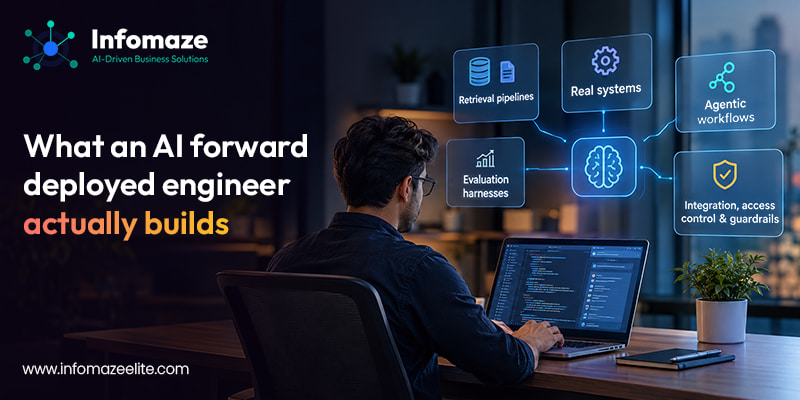
Retrieval pipelines grounded in the client's own data
Connecting a model to a company's actual documents, databases, and knowledge bases — often called retrieval-augmented generation (RAG) — so its answers are grounded in that business's real information instead of general training data.
Building directly against real systems
Unlike a product team working primarily in a controlled environment, an FDE often works against the client's real data structures and integrations — or representative data where security and privacy requirements require it — which can surface the messy edge cases a generic build might only find much later.
Agentic workflows for multi-step tasks
Systems that don't just answer a single question but carry out a sequence of steps — pulling data, taking an action, checking the result — against the client's actual tools and systems.
Evaluation harnesses
A way to actually measure whether the model's output is reliable enough for that specific use case, rather than assuming a benchmark score translates to real-world performance on the client's data.
Integration, access control, and guardrails
The unglamorous but essential layer that lets an AI system run safely inside a regulated or otherwise sensitive environment — authentication, permissioning, logging, and limits on what the system is allowed to do on its own.
AI FDE vs. applied AI engineer vs. traditional FDE
Traditional (Palantir-era) FDE
- Embeds with government and enterprise clients on complex operational problems
- Builds against structured data and existing systems
- Core skill: software engineering plus domain fluency
AI forward deployed engineer
- Embeds with enterprise clients adopting AI specifically
- Builds RAG pipelines, agentic workflows, evaluation systems
- Core skill: software engineering plus real production LLM experience
The "applied AI engineer" title, used at Anthropic and other AI companies, can overlap significantly with AI FDE work in day-to-day practice. The main practical difference tends to be organizational: an applied AI engineer often sits closer to a company's research or product function, while a forward deployed engineer is defined primarily by customer embedding. For a business evaluating a partner or a candidate, the title matters far less than whether the person has actually shipped a model into a live, production environment.
A demo proves what a model can do. Getting it running safely inside one company's actual systems is where an AI forward deployed engineer earns the title.
The same deployment discipline, applied to your systems
Retrieval pipelines grounded in your own data, workflow automation built around how your team actually works, and integration done with the right guardrails — that's the AI deployment work we do through our AI workflow automation and LLM & RAG integration practices.
What this means if your company isn't OpenAI or Anthropic
Most businesses adopting AI right now aren't trying to hire a forward deployed engineer with that exact title — and they don't need to. What they need is the same underlying discipline: a model connected properly to their own data and systems, evaluated against their real use case rather than a generic benchmark, and shipped with the access controls a production environment actually requires.
That's primarily a deployment problem, not just a model-selection problem. Companies can address it through an internal engineering team, an external implementation partner, or a combination of both. The important part is treating AI implementation as iterative engineering work — connecting the model to real systems, evaluating it against real workflows, and refining it based on how it performs in production — rather than treating model selection as the end of the process. It's the same reasoning that applies to forward deployed engineering more broadly: the delivery model is what matters, not the job title on the account.