Mysuru
Manufacturing & industrial base
From Mysuru's manufacturing floors to Bengaluru's tech corridors and Mangaluru's port operations, here's how mid-market enterprises are turning Zoho into a real operating system — not just a CRM subscription.
Businesses across Karnataka — in Mysuru's industrial base, Bengaluru's tech sector, and Mangaluru's port and logistics operations — hire Zoho developers to unify sales, finance, and operations into one connected system. That typically means Deluge script optimization, multi-app database synchronization between Zoho CRM, Books, and Creator, and custom API webhooks built around regional business requirements.
Karnataka has spent the last two decades building a reputation as South India's software and manufacturing engine. What's changed more recently is who's actually using enterprise-grade software — it's no longer just the large IT parks in Bengaluru. Middle-market manufacturers in Mysuru, logistics operators near Mangaluru's port, and service businesses scattered across the state's smaller commercial hubs are all running into the same wall: their tools don't talk to each other.
Sales tracked on a spreadsheet. Accounting on a separate local application. Customer support handled over email threads that nobody can search six months later. It's an extremely common setup, and it works fine right up until the business tries to grow past it — at which point every one of those disconnected tools becomes a bottleneck someone has to manually patch over.
Fixing that isn't a matter of buying more software. It's a matter of getting the software you already have to execute your actual business logic — which is where Zoho's own scripting language, Deluge, does the real work that drag-and-drop configuration can't.
That's the shape most Zoho deployments end up taking once sales, finance, and field operations stop running as separate systems and start feeding one shared data layer.
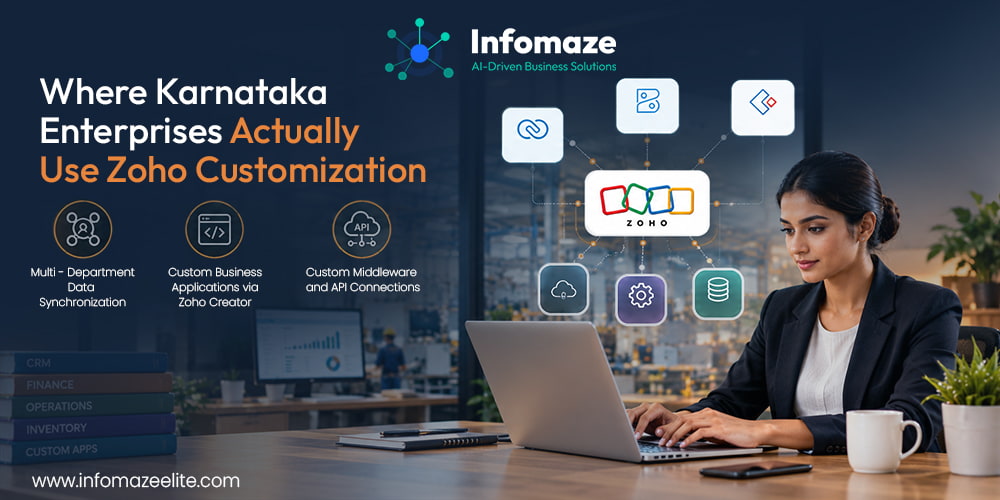
The classic failure point: a deal closes in Zoho CRM, and someone has to manually re-key the client's details into Zoho Books, or into a separate ERP entirely. Every manual re-entry is a chance for a typo, a missed field, or a day's delay. Certified developers close that gap with automated triggers, so that:
When the workflow is specific enough that no off-the-shelf module fits, Zoho Creator gives Karnataka businesses a low-code way to build exactly what they need:
Linking Zoho to on-premise legacy systems — which is still common across Karnataka's manufacturing sector — usually means building custom middleware with OAuth 2.0 authentication, rate-limit buffers, and retry queues, so data stays consistent even when a factory floor connection drops mid-sync.
The bottleneck was never the Zoho subscription. It was getting the platform to run the business logic that actually exists on the ground in Mysuru or Mangaluru, not the generic version in the demo. Infomaze Zoho Engineering Team
Once a Karnataka business decides it needs real Zoho customization rather than basic setup, the next decision is usually who builds it. The two common paths look different enough that it's worth laying them out side by side.
| Consideration | Large Metro Agency | Dedicated Engineering Partner |
|---|---|---|
| Developer continuity | Rotates frequently — high attrition | Same developer across the project lifecycle |
| Discovery process | Usually remote, templated intake forms | Direct workflow mapping, often on-site |
| Certification & security | Varies widely by vendor | ISO 9001 / ISO 27001 backed, documented process |
| Post-launch support | Often a separate support contract | Retainer continuity with the original build team |
| Cost structure | Higher overhead, metro pricing | Regional delivery cost with enterprise process |
Neither model is automatically wrong — a large agency can be the right call for a very short, well-defined build. But for ongoing CRM and Creator work that needs to evolve as the business does, continuity tends to matter more than brand size.
Tell us where your Zoho setup is breaking down — CRM, Books, Creator, or the connections between them — and we'll return a matched developer shortlist within 24 hours.
Get My Zoho Developer Shortlist →