Whether buyers are asking ChatGPT for a recommendation or Google is generating an AI Overview, Infomaze Elite's Generative Engine Optimization (GEO) service structures your content, data and authority signals so AI models cite your business by name - not a competitor's.
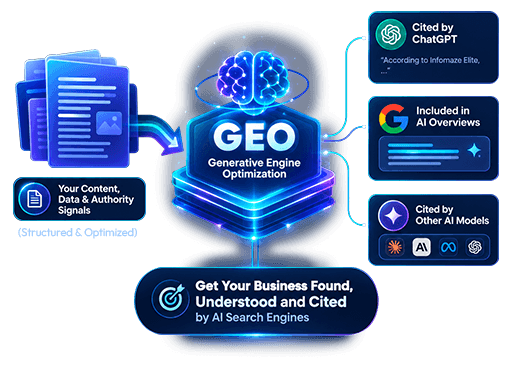
A growing share of research now starts inside a chat window instead of a search bar. When someone asks an AI model to recommend a vendor, tool, or service in your category, that model pulls from a narrow set of sources it trusts - and if your content isn't structured for that, you simply don't get mentioned.
Generative Engine Optimization solves this by bringing structure, schema and verifiable credibility to your content - so instead of hoping an AI model finds you, you're building the exact signals it's designed to look for.
AI models don't crawl and rank pages the way search engines do - they retrieve, verify and summarize. Our GEO service covers every stage of that process, from auditing your current AI visibility to monitoring citations after the work goes live.
A baseline check of how ChatGPT, Perplexity, Gemini and AI Overviews currently describe - or ignore — your brand today.
Existing and new pages rewritten into clear, direct, verifiable answers that AI models can extract with confidence.
Organization, FAQ, and entity schema markup that gives AI systems a machine-readable way to verify who you are.
Citations, author credentials and trust signals that give AI models a reason to treat your content as a reliable source.
Ongoing tracking of where and how your brand is mentioned across AI platforms, reviewed against your competitors.
Crawlability, indexing and site structure fixes that ensure your content is reachable by both search and AI crawlers.
Being cited by an AI model isn't a vanity metric - it changes when and how buyers first encounter your brand.
A well-executed GEO program does more than earn the occasional mention - it builds a durable presence inside the tools your buyers increasingly research with.
Show up at the research stage, before a prospect has even opened a search engine or built a shortlist.
Being cited by an AI model reads as an implicit endorsement, carrying more trust than a paid placement.
Schema and credibility work built for GEO also strengthens your traditional SEO performance.
Organic AI visibility lowers reliance on paid search as more research moves into chat interfaces.
Most competitors haven't structured content for AI extraction yet — early, correct work is hard to catch up to.
Well-structured, verified content reduces the risk of AI models describing your business inaccurately.
GEO and traditional SEO aren't competing strategies - they're two different games played on the same field.
| Generative Engine Optimization | Traditional SEO |
|---|---|
| Optimizes for citation inside an AI-generated answer | Optimizes for a ranked position on a results page |
| Success measured by brand mentions and citation accuracy | Success measured by rank position and click-through rate |
| Content built for extraction and verifiability | Content built for keyword relevance and search intent |
| Relies on structured data and credibility signals | Relies on backlinks and on-page optimization |
| An emerging discipline with limited competition today | A mature discipline with established best practices |
For most businesses, the two work best together. Our GEO service builds directly on the technical and content foundation delivered through search engine optimization, rather than replacing it.
No black-box reporting - you'll know exactly what's happening and why at every stage.
We assess how ChatGPT, Perplexity, Gemini and AI Overviews currently describe — or omit — your brand and competitors.
We map priority topics and questions, then plan the schema and structure needed to support citation.
Pages are restructured into clear, verifiable answers written for extraction without losing readability.
Organization, FAQ and entity schema are implemented across priority pages and validated for accuracy.
We track citation movement monthly and refine content based on what's actually getting pulled by AI models.
Most businesses we start GEO work with have a well-ranked website and little to no presence in AI-generated answers - the content exists, but it's written in a way that's hard for an AI model to lift a confident, accurate answer from.
Our first engagement usually focuses on a client's highest-intent pages: restructuring the opening of each section to answer the core question directly, adding FAQ and entity schema, and building out author and organization credibility signals that give AI models a reason to trust the source.
"The goal isn't to trick an AI model into citing you - it's to make your content the clearest, most verifiable answer available, so citing you is the obvious choice."
How buyers research varies by industry - our GEO strategy adapts to how your specific audience uses AI tools.
Getting your product named when buyers ask AI tools to compare software options.
Building the credibility signals AI models look for before recommending a firm.
Structuring accurate, verifiable information so AI tools represent your services correctly.
Trust-driven content and schema for compliance-sensitive financial queries.
Product and category content structured to be pulled into AI shopping recommendations.
Getting technical capabilities represented accurately in long, research-driven buying cycles.
GEO fundamentals - clarity, structure and credibility — apply across every industry. We build the strategy around your buyers' actual research behavior, not a template.
GEO work sits on top of proper technical and content SEO, not a standalone patch job.
The same team researching, writing and implementing schema - no handoffs between departments or vendors.
Monthly reporting on brand mentions and citation accuracy, reviewed on a call, not buried in a spreadsheet.
Every page is written by a person who understands your industry, then structured for AI extraction — never AI-generated.
Schema and technical implementation handled by the same engineers who build our clients' web platforms.
ISO 9001:2015 and ISO/IEC 27001 certified processes, with confidentiality agreements available on request.
Generative Engine Optimization is the practice of structuring a website's content, data and authority signals so AI systems like ChatGPT, Perplexity, Gemini and Google AI Overviews cite that business by name when generating an answer, rather than optimizing purely for a ranked position on a results page.
Traditional SEO competes for a ranked position on a search engine results page, measured by clicks and rank. GEO competes to be the source an AI model pulls from and cites inside a generated answer, measured by brand mentions and citation accuracy instead of rank position.
Our GEO work is built around how ChatGPT, Perplexity, Google Gemini, Microsoft Copilot and Google AI Overviews retrieve and cite information, since these currently account for the largest share of AI-assisted research and buying decisions.
We track brand mentions and citations across AI platforms, the accuracy of how your business is described, which pages are being pulled as sources, and how that trend moves month over month alongside your regular SEO reporting.
Not reliably. AI engines lean heavily on well-indexed, technically sound, authoritative websites as source material, so GEO builds on the same technical and content foundation as traditional SEO rather than replacing it.
Because AI models refresh their retrieval sources on different cycles than search engines, initial citation movement can appear faster than traditional rankings for well-optimized pages, though a full program typically needs three to six months to show consistent results.
Content is always written for people first and structured for AI extraction second — an answer that's clear and accurate for a human reader is also what AI models prefer to cite, so the two goals rarely conflict.
No. Because GEO is still an early discipline, smaller and mid-sized businesses that structure their content correctly can be cited by AI models ahead of larger competitors who haven't optimized for it yet.
Get a free assessment of how AI models currently see your brand - and what it would take to change that.