Enterprise AI Assistants
Connect AI with internal knowledge and business systems.
Some engineering problems do not arrive with a complete specification. Infomaze Forward Deployed Engineers work directly with your product, engineering and business teams to understand the problem, design the solution and take it through to production.
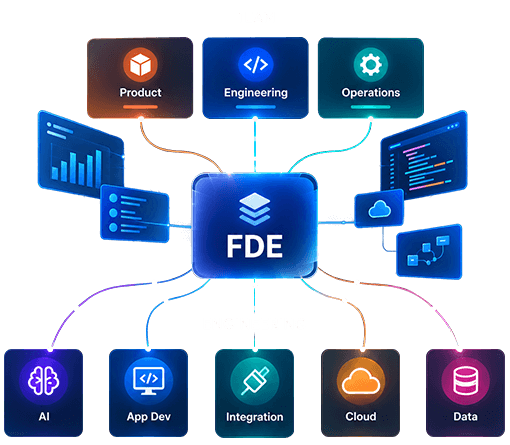
Most engineering leaders don’t need more developers — they need developers who understand the problem well enough to solve it without constant hand-holding. Traditional outsourcing and staffing models may not provide the level of business context and collaboration some teams require.
Understand the business and technical problem
Design, prototype and integrate
Take the solution into production and improve it
Forward deployed engineering exists to close that gap: engineers who work inside your team’s process, not outside it.
Forward deployed engineering (FDE) is a hands-on engineering model where experienced engineers work directly with the customer to solve complex technical and operational problems.
Instead of receiving a completed specification and developing from a distance, the Forward Deployed Engineer becomes closely involved in the problem itself.
They work with users, product owners, engineering teams and business stakeholders to understand how the current system works, where the limitations are and what a practical solution should look like.
The engagement may involve architecture, application development, AI, integrations, data, cloud infrastructure or a combination of several technologies.
The objective is simple: Understand the problem. Build the solution. Put it into production. Learn from real usage. Improve it.
Not every project requires a Forward Deployed Engineer.
You may not need an FDE for every software project. It becomes particularly useful when the problem crosses teams, systems or technologies and the complete solution is not yet defined.
You have built an AI proof of concept but need to connect it securely to real systems and data.
CRM, ERP, APIs, legacy applications and third-party platforms need to work together.
An important customer needs functionality or integrations outside your standard product.
A critical application needs to evolve without an immediate full replacement.
You understand the business problem but do not yet know the right engineering solution.
Your product or engineering team needs senior technical ownership to move a critical initiative forward.
| Staff Augmentation | Traditional Outsourcing | Forward Deployed Engineering | |
|---|---|---|---|
| Starts With | Defined role | Defined specification | Business / technical problem |
| Works Closely With Customer | Sometimes | Periodically | Continuously |
| Helps Define Solution | Limited | Usually before delivery | Yes |
| Hands-on Engineering | Yes | Yes | Yes |
| Works Within Existing Environment | As assigned | Based on scope | Core part of role |
| Iterates With Users | Limited | Project dependent | Yes |
| Production Ownership | Task based | Project based | Discovery through production |
| Best For | Extra capacity | Defined project | Complex evolving problem |
Build the smallest useful working solution
Working softwareThe objective is not to spend months writing the perfect specification. It is to move responsibly from a real problem to working software.
A Forward Deployed Engineer does not need to solve every specialist problem alone. When deeper expertise is required, the engineer can bring in the relevant Infomaze team.
One embedded engineering relationship. Broader specialist capability when required.
Building an AI demonstration is increasingly easy. Making it work reliably with real company data, permissions, workflows and production systems is much harder.
Connect AI with internal knowledge and business systems.
Let AI understand emails, documents and requests before triggering workflows.
Add summarisation, search, validation, recommendations or natural-language interfaces to existing applications.
Build controlled AI workflows that can retrieve data, call APIs, update systems and request human approval.
Enterprise customers need functionality outside the standard platform.
Take an AI prototype into a secure production environment.
Modernize a legacy platform gradually without disrupting the business.
Connect systems that currently require manual data movement.
Remove repetitive operational work across teams and applications.
Connect fragmented data and make it usable for reporting and decisions.
Implement a complex solution inside a customer's technical environment.
Help internal teams accelerate an important roadmap initiative.
All three include NDA before day one, ISO 27001 certified process, and ROI modelled before any development commitment.
For customer-specific integrations and product expansion.
For complex internal transformation projects.
For product, engineering and deployment challenges.
For projects requiring deeper engineering capabilities.
For implementation inside client environments.
For difficult workflows spanning several business systems.
Sometimes the Right Answer Is AI. Sometimes It Isn’t.
We do not begin every engagement by recommending a new application or AI model.
Our job is to understand the problem first.
Choosing the right partner is about more than writing code — it's about finding a team that identifies opportunities for automation, recommends the right technologies, and designs applications that keep delivering value as your business grows.
Infomaze brings more than two decades of software engineering experience to embedded development engagements — that depth carries into how our engineers work with your team.
Our FDEs are selected for their ability to understand a business problem, not just execute a spec.
ISO 9001:2015 and ISO 27001 certification mean your engagement follows documented quality and security processes.
You work directly with your engineers — Direct collaboration with your engineering and product stakeholders, aligned with the agreed engagement model.
Scale from a single fractional engineer to a full embedded pod as your needs change.
We support confidentiality through NDAs and agreed contractual terms.
A Forward Deployed Engineer is an experienced engineer who works closely with a customer to understand a technical or business problem and help take the solution from discovery through implementation and production.
The role typically combines software engineering, solution architecture, problem solving and customer collaboration.
A software developer usually works against defined requirements, product features or technical tasks.
An FDE is normally involved earlier. They help understand the requirement, identify the right technical approach and often remain responsible through implementation and deployment.
No. Staff augmentation normally adds engineering capacity to an existing team against roles and tasks the customer already understands.
Forward Deployed Engineering is more problem-oriented and generally includes discovery, technical decision-making and delivery ownership.
Yes. That is often the preferred model. The Forward Deployed Engineer can work directly with your developers, product team, architects, operations staff and other stakeholders.
The engagement can be remote, hybrid or include onsite involvement depending on the nature of the project and location.
The important part is close access to the teams and users involved in the problem.
Yes. Forward Deployed AI Engineers can help with enterprise AI assistants, RAG, agent workflows, AI integrations, model evaluation, data connections and moving AI prototypes into production.
Both models are available. You can engage a dedicated Forward Deployed Engineer or use an FDE-led pod with additional developers, AI engineers, QA, DevOps or data specialists.
No. In many cases, the reason for involving an FDE is that the complete solution is not yet known.
A clear description of the business problem, current systems and desired outcome is enough to begin the discovery process.
Tell us what your team is trying to achieve, where the current process or technology is breaking down, and which systems are involved.
We'll help determine whether Forward Deployed Engineering is the right delivery model and what the first practical step should be.