An eight-person technology and digital transformation consultancy in the Pacific Northwest kept losing build-stage work to bigger firms - not because their advice was worse, but because they had nobody to build what they recommended. Eighteen months into a partnership with Infomaze, they've delivered twelve client projects under three different engagement models without adding a single engineer to their own payroll.
Boutique technology & digital transformation consultancy, USA (name withheld under partner NDA)
Technology Execution & Software Development Partner
White-label delivery → Dedicated team → Co-build
Custom software development, Zoho implementation, AI workflow automation, cloud migration
18 months, ongoing
Healthcare, logistics, professional services, SaaS
The consultancy's founders had spent years in enterprise IT before going independent, and their strategic advice was never the problem. Clients hired them to figure out what to build - a customer portal, a Zoho-based operations backbone, an AI intake tool - and the diagnosis was consistently sharp. The trouble started right after the recommendation landed, when the client's next question was always some version of "so who builds this?"
With no in-house engineering bench, the consultancy had three bad options: recommend the client hire their own developers (and often lose the relationship to whoever the client hired), refer the whole engagement to a larger firm (and lose the account entirely), or quietly pass on projects that required real build capacity. Over two years, they estimated they had turned away or lost close to a dozen engagements this way - work they had scoped, priced, and were ready to advise on, but couldn't deliver.
The consultancy didn't need a single vendor for a single project. They needed a delivery partner flexible enough to sit underneath a strategy practice permanently - sometimes invisible, sometimes embedded, depending on what each client relationship called for.
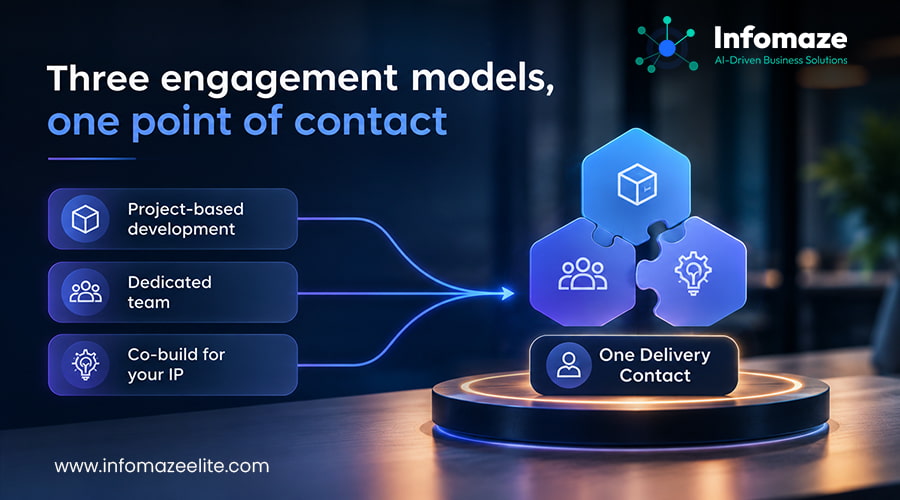
For clients who needed one clearly scoped build - a portal, an integration, a Zoho rollout - Infomaze delivered entirely under the consultancy's brand, with the consultancy setting the client-facing price and margin.
After the first four projects landed cleanly, the consultancy shifted its two largest, longest-running clients onto a small ring-fenced Infomaze team billed monthly - giving those clients continuity of engineers across multiple phases of work instead of a new team for every new statement of work.
Eight months in, the partnership expanded again: the consultancy wanted to package one of its recurring engagements - an AI-assisted intake workflow it kept rebuilding for different clients - into a reusable product. Infomaze co-built the first version as joint IP rather than a one-off client delivery.
Regardless of which model was active on a given project, the consultancy dealt with a single Infomaze delivery lead, which meant the founders never had to re-explain context to a new account manager every time a new project started.
A responsive interface, role-based dashboards, and simplified navigation meant staff needed almost no retraining - the workflows they already knew just had far fewer manual steps in them.
The instinct in most partner relationships is to lock in one engagement model early and stay there. That would have undersold this partnership. A two-week integration and a six-month product build have almost nothing in common operationally, and forcing both through the same contract structure would have meant over-processing the small work or under-resourcing the large work. Letting the model shift project to project - while keeping the relationship, the delivery lead, and the trust constant - is what let the consultancy say yes to engagements it would previously have turned down.
A software development partner is only as useful as its flexibility. If you're a consultancy, agency, or technology company evaluating an outsourced engineering partner, the question worth asking isn't just "can they build it" - it's "can this relationship stretch from a two-week integration to a year-long product roadmap without starting over each time." That's the difference between a vendor and a partner.
Since the first white-label project closed, the consultancy has stopped declining build-stage work. Twelve projects have shipped across five industries, three of the four largest clients have expanded their engagement at least once, and the co-built intake product is now being piloted with two additional consultancy clients as a licensed add-on rather than a bespoke rebuild each time.
Perhaps the more important number is a soft one: in eighteen months, no client has asked who actually built the software. The consultancy has been able to grow its average project size roughly threefold - from single-feature engagements to full platform builds - without changing its own headcount, hiring plan, or overhead.
We work as a white-label software development team, a dedicated engineering extension, or a co-build partner - whichever shape fits the engagement in front of you.