If you've read our piece on the five signs your legacy system is costing you more than it's saving, you already know how to tell whether a system needs attention. This guide picks up from there: once you know modernization is the right call, what are you actually choosing between, how do you sequence it without stopping the business, and what does it realistically cost.
- Legacy system modernization is the process of updating an ageing application's technology, architecture, or infrastructure so it can keep pace with current security, integration, and business needs — without necessarily rebuilding it from scratch.
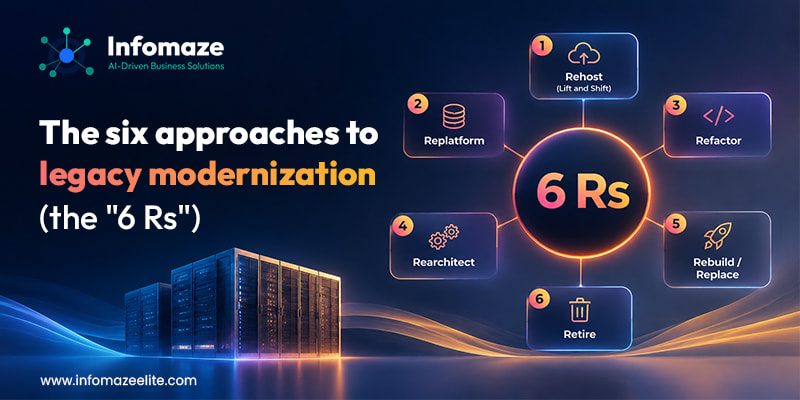
- There are six standard approaches: Rehost, Replatform, Refactor, Rearchitect, Rebuild, and Retire — often summarised as the "6 Rs."
- Most successful projects use more than one approach across different parts of the same system, sequenced to avoid downtime, rather than picking one approach for the whole system.
What "legacy system modernization" actually covers
The phrase gets used as a catch-all, which causes real confusion at the planning stage. Modernization doesn't automatically mean a full rebuild — in fact, a full rebuild is usually the least common and highest-risk of the available paths. At its core, legacy modernization means closing the gap between what a system currently runs on (and how it's built) and what the business now needs from it — whether that gap is security, integration, speed of change, or simply finding people who can still maintain it.
A useful way to frame the decision: modernization is not one project, it's a set of six distinct approaches, and the right answer is almost always a mix of them applied to different parts of the same system — not one approach applied uniformly.
For years, "automation" meant one tool doing one job — a bot filling a form, a script moving a file. Hyperautomation is the shift toward connecting AI, robotic process automation (RPA), APIs, and workflow platforms so an entire process runs end-to-end, across systems that previously required a human to bridge them manually. Market researchers now put hyperautomation on a steep growth curve, with the segment forecast to more than double over the next several years as companies move past single-point automations toward orchestrating whole processes.
Rehost ("lift and shift"):
Move the existing application onto modern infrastructure — typically cloud — with minimal changes to the code itself. Fastest and lowest-risk option, but it doesn't fix anything structurally wrong with the application; it just moves the same problem onto newer hardware.
Replatform:
Move to modern infrastructure and make targeted changes to take advantage of it — swapping an outdated database engine, for instance — without a full code rewrite. A middle ground between rehosting and refactoring.
Refactor:
Restructure and clean up the existing codebase without changing what the system does externally. This is where the "one or two people understand it" and "business logic is tangled" problems actually get fixed.
Rearchitect:
Redesign how the application is structured — commonly, breaking a single large application into smaller, independently deployable services. Higher effort, but it's what makes a system genuinely easy to extend going forward.
Rebuild / Replace:
Build a new system from the ground up, or replace the legacy application with a modern commercial or SaaS product. Highest cost and risk, reserved for systems where the existing code is beyond reasonable repair or the business model has changed enough that the old system's assumptions no longer apply.
Retire:
Some legacy components turn out not to be worth modernizing at all — their function has been absorbed elsewhere or is no longer needed. Retiring a component cleanly is itself a modernization outcome, and often the cheapest one.
The choice usually comes down to three questions, asked component by component rather than for the system as a whole:
Is the problem infrastructure, code, or architecture?
An end-of-support server points to rehosting. Tangled, undocumented business logic points to refactoring. A system that can't scale or integrate points to rearchitecting.
How much risk can the business absorb right now?
Rehosting and replatforming carry low operational risk. Rearchitecting and rebuilding carry real risk if not sequenced carefully — which is the next section.
Is this component actually still earning its place?
Before investing in modernizing anything, it's worth confirming the function still matters to the business. Retiring is always cheaper than modernizing.
The single biggest risk in any legacy modernization project isn't picking the wrong approach — it's a big-bang cutover, where the old system is switched off and the new one switched on in one event. Even a well-built replacement can fail in ways that only show up under real production load, and by then there's no fallback.
The approach that consistently works better is incremental: keep the legacy system running exactly as it always has while individual components are migrated, wrapped, or rebuilt one at a time, and traffic is gradually shifted over. This is often called the strangler fig pattern — the new system grows up around the old one, piece by piece, until the legacy core is no longer doing any real work and can be safely switched off.
- Identify the highest-risk or highest-cost component first — usually the piece with the fewest people who understand it, or the highest ongoing maintenance spend.
- Build an integration layer or API wrapper around the legacy system so new components can talk to it safely without touching its internals.
- Migrate or rebuild that one component while the rest of the system keeps running unchanged.
- Run both in parallel briefly, routing a small share of real traffic to the new component before fully cutting over.
- Repeat, component by component, until the legacy core is either fully replaced or reduced to a small, well-understood remainder.
"A legacy system rarely fails all at once. It costs a little more every quarter until someone finally adds it up. Modernization done right works the same way in reverse — a little better every quarter, with the business never having to hold its breath through a single cutover weekend."
Data migration errors:
Years of accumulated data — including edge cases and inconsistencies nobody remembers creating — is often the hardest part of any migration, not the code. Budget real time for data validation, not just data transfer.
Scope creep disguised as "while we're in there:
Modernization projects are an easy place to bolt on new features. Every addition extends the parallel-run period and adds risk; keep the first pass focused on parity, and treat new features as a separate phase.
Underestimating institutional knowledge loss:
If the people who understand the legacy system's quirks aren't closely involved in the modernization project, the new system tends to quietly reproduce old bugs or miss undocumented business rules.
Budget built around the build, not the migration:
The cutover, data validation, parallel running, and staff retraining commonly cost as much as the development itself, and get underestimated more often than any other line item.
Budgeting for modernization: how to build the business case
The strongest business case rarely leads with strategy — it leads with the number leadership already half-knows but has never actually calculated: total maintenance spend over the last two years, including specialist contractor premiums, rising license or support costs, and the opportunity cost of developer hours spent maintaining rather than building. In most modernization projects we scope, that number alone justifies the investment before anyone raises the harder-to-quantify strategic case — faster feature delivery, easier hiring, reduced security exposure.
From there, cost planning should follow the same component-by-component logic as the technical approach: price the highest-risk piece first, on its own, rather than trying to estimate a full-system rebuild up front. It's both more accurate and easier for leadership to approve in stages.
Not sure which approach fits your system?
We've spent over two decades migrating businesses off Classic ASP, legacy PHP, and ageing .NET systems — almost always without downtime. A free 30-minute review gives you an honest read on risk, cost, and the right modernization path.