How to Choose a Custom Software Development Company (Without Getting It Wrong)
⚡ Quick Answer
The most important factors when choosing a custom software development company are the experience of the team assigned to your project, a transparent sprint-based delivery process with visible progress, clearly defined IP ownership in the contract, relevant industry experience, a well-defined post-launch support model, and verifiable client references. While portfolios and sales conversations provide useful context, they shouldn't be your only decision-making criteria. The questions below will help you identify a partner that can consistently deliver successful software projects.
Most custom software projects don't fail because the technology was wrong. They fail because the company hired to build the software wasn't the right partner — and the warning signs were there before the contract was signed, but nobody knew what to look for.
The market for custom software development companies is enormous and unevenly distributed. For every excellent partner, there are a dozen who look equally convincing in a sales presentation. This guide is about the six questions that reveal the difference — and why the obvious signals (a polished website, impressive client logos, glowing testimonials) tell you almost nothing useful.
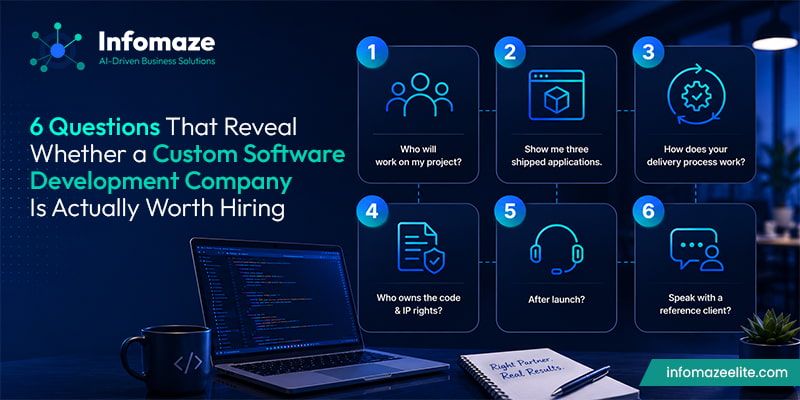
6 Questions That Reveal Whether a Custom Software Development Company Is Actually Worth Hiring
Who specifically will work on my project — and can I meet them?
This is the single most important question you can ask, and it's the one most people forget to ask. The sales team, the account manager, and the technical lead who impresses you in the pitch are often not the people who will write your code.
The standard playbook for underpowered custom software development companies is to present senior engineers in the sales cycle and execute with junior developers. It works in the short term because nobody asks. Don't be nobody.
Ask for the CVs of the specific developers assigned to your project. Ask to meet them in a video call before signing. Ask whether the team will remain consistent through the project or whether staffing changes regularly. A strong development partner will welcome these questions — because their team is one of the things they're most proud of.
✓ Strong signal
They introduce specific developers by name, share their experience, and arrange a pre-contract call with the people who will actually build your product.
✗ Warning sign
They talk about "our team" in aggregate, emphasise company certifications over individual capability, or can't tell you who will be on your project before you sign.
Can you show me three shipped applications — not demos — and let me use them?
Every custom software development company has a portfolio. Most portfolios contain screenshots, case study PDFs, and client logos. Almost none of them give you the thing that actually matters: access to working software you can interact with.
Ask for live applications built for previous clients. Ask for the App Store or Play Store links if they built mobile applications. Ask for the URL of the web application and try to use it. A demo environment is not the same thing — demos are built to be shown, not used. Live production software is built to be used by real people over time, and the quality difference between a polished demo and a production application is usually very visible.
When evaluating the portfolio, look for work in your domain or an adjacent one. A company that has built logistics software understands operational constraints that a company that has only built marketing websites simply doesn't.
✓ Strong signal
They share live, working applications. They explain the business problem each one solved. They're comfortable with you actually trying to use the software, not just look at screenshots.
✗ Warning sign
The portfolio is screenshots only, or they describe projects in vague terms without being able to show you anything running. They emphasise design awards over business outcomes.
How does your delivery process work — and what will I see at the end of each two weeks?
The delivery process is where the real quality of a custom software development company shows itself. Not in the sales pitch. Not in the contract. In what actually happens between kickoff and launch.
The standard for professional software development is sprint-based delivery — typically two-week cycles — with working, demonstrable software at the end of each sprint. This gives clients visibility into progress without requiring them to read code or interpret Gantt charts. It creates natural checkpoints for feedback and course correction. And it means that if something is going wrong, you find out six weeks in — not six months in.
Ask what you will specifically see at the end of each two weeks. Ask how scope changes are handled. Ask what the QA process looks like and who is responsible for testing. Ask how bugs found after a sprint closes are handled. A company with a real process will have real answers to these questions.
✓ Strong signal
They describe a sprint-based process, explain what a sprint review looks like, have a clear change management process, and can tell you exactly who handles QA and when.
✗ Warning sign
They describe "agile methodology" in general terms without being able to tell you specifically what you'll see and when. Or they propose fixed-price delivery with no visibility until the final handover.
The question to ask
"Walk me through what happens in a typical two-week sprint on a project like mine — what do I see at the end of it, and how do we handle it if I don't like what I see?"
Ready to evaluate whether Infomaze is the right fit for your project?
We'll introduce you to the specific developers who would work on your project, walk you through our delivery process, and give you honest answers to every question on this list.
Who owns the code — and what does your IP agreement actually say?
This should not be a difficult question to answer. Everything built under your engagement — the code, the design assets, the database schema, the documentation — should be your property, unconditionally, from the moment it's created. This should be explicit in the contract, not implied by general commercial practice.
The reason this matters is not paranoia. It's that IP disputes, however unlikely, are disproportionately expensive to resolve. And some development agreements — particularly those from smaller firms or freelancers — contain licensing language that gives the developer ongoing rights to the work. Know what you're signing.
Ask to see the IP clause before you negotiate anything else. It should say, in plain language, that all work product created under the agreement is assigned to the client upon payment. If it doesn't say that clearly, ask for it to be changed. If the company resists, walk away.
✓ Strong signal
Full IP assignment is standard in their contracts and they can point you to the clause immediately. They've had this conversation many times and it's not a negotiation.
✗ Warning sign
They talk about IP in vague terms, use language like "licence to use" rather than "assignment of ownership," or push back on adding explicit IP language to the contract.
What happens after launch — and what does your support model look like?
The most common failure point in custom software development is not the build itself — it's what happens in the first six months after launch. OS updates introduce compatibility issues. User behaviour reveals edge cases that testing didn't catch. The business changes and the software needs to change with it.
A development company that treats launch as the finish line is a company that will be difficult to reach when you need them most. Before signing anything, establish what the ongoing relationship looks like, how bug fixes are handled post-launch, what the commercial terms of ongoing support are, and whether the team who built the software will be available for maintenance and enhancements.
✓ Strong signal
They have a clearly described post-launch support model, can tell you the commercial terms, and reference clients they've been supporting for years after the initial project.
✗ Warning sign
Post-launch support is an afterthought in the conversation, or they describe it as "we'll figure that out after launch." A company that hasn't thought about this hasn't planned for your long-term success.
Can I speak with a reference client in my region — not read a testimonial?
Testimonials on a website are curated, edited, and presented without context. A conversation with a real client who has been through a full engagement — from kickoff to launch to post-launch — is the most reliable signal available.
Ask for two or three reference clients in your region. A US business should speak with another US client. A UK or Australian business should speak with someone operating under similar conditions. Ask them about the delivery process, communication, how the company handled problems when they arose, and whether they would hire the company again. Pay attention to how they answer the last question.
A strong custom software development company will have references available and will connect you quickly. A company that hedges — "we'd need to check with the client first" and then takes two weeks to produce a name — is telling you something.
✓ Strong signal
They offer references proactively, connect you within a few days, and the reference client speaks candidly about both the strengths and the challenges of working with the company.
✗ Warning sign
References are slow to materialise, are only available via written testimonial, or the conversation feels like a coached performance rather than a candid client perspective.
"The best custom software development companies don't try to win you over in the pitch. They try to give you everything you need to make a good decision — because they're confident you'll pick them if you look hard enough."
What choosing the right company actually looks like
After going through these six questions seriously, you'll find that the number of genuinely strong options narrows quickly. Most companies that look equivalent in a Google search are not equivalent when you ask these questions. Some will struggle to name the developers assigned to your project. Some won't have live production work to show you. Some will get evasive about IP. The ones that pass every test — that can answer every question directly, introduce you to real people, and give you references who speak candidly — are the ones worth working with.
The goal is not to find the cheapest option or the most impressive name. It's to find a partner who will deliver working software, on time, that your business can actually use and evolve over the years ahead. That company exists at a range of price points and in a range of geographies. The questions above will find them.
A note on evaluating offshore custom software development companies
Many of the best answers to the search "custom software development company" lead to companies based in India, Eastern Europe, or Latin America. This is worth addressing directly: location is not the primary quality signal. Process is.
An excellent offshore custom software development company with senior engineers, a sprint-based process, strong QA, and verifiable references will outperform a mediocre local company on every dimension except the ability to meet in person. For businesses in the US, UK, and Australia where senior local development talent is expensive and scarce, the offshore model — structured correctly — delivers exceptional value.
The six questions above apply equally to offshore and onshore companies. A company's location should not change your expectations of transparency, process quality, or IP protection.
One thing worth knowing
The discovery phase — typically two to four weeks before development begins — is the clearest signal of a company's quality. It produces a written scope document, technical architecture, and project plan. Any company that wants to skip discovery and go straight to development is either underestimating the work or has incentives to start billing before the scope is clear. Invest in discovery. It protects you.