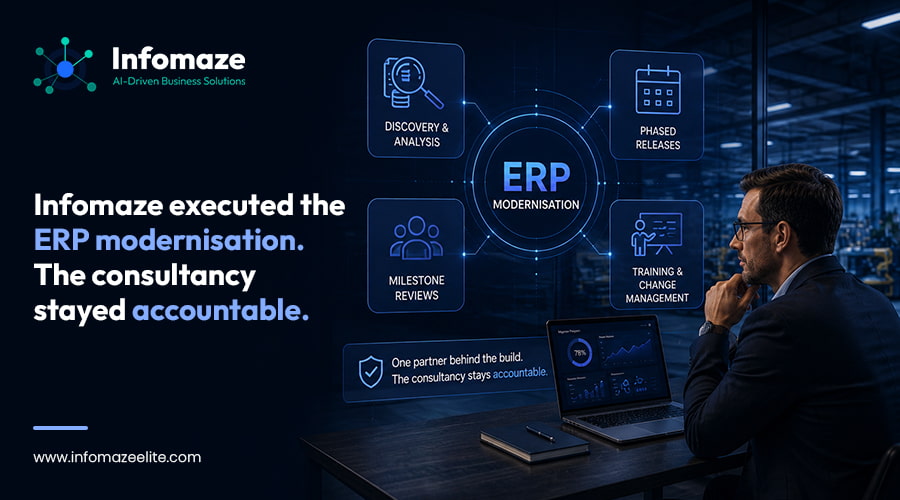
A digital transformation consultancy in Manchester had diagnosed exactly what its manufacturing client needed: a phased move off a 15-year-old on-premise ERP system. What they didn't have was the engineering capacity to build the migration themselves - and no appetite to hand the client to a systems integrator who might keep them after the project ended. Infomaze executed the migration as their delivery partner. The consultancy stayed in the room for every strategic decision, and kept the account.
Digital transformation consultancy, Manchester, UK (name withheld under partner NDA)
Technology Execution Consulting Partne
Mid-sized manufacturing business (consultancy's client)
White-label execution under a consulting-led engagement
ERP modernisation, legacy ERP migration, phased data migration, staff training handoff
7 months, phased delivery
The consultancy had spent six weeks with the manufacturing client mapping out exactly why their existing ERP system - a heavily customised, on-premise platform installed in the early 2010s - was becoming a liability: no vendor support past the current version, a reporting layer nobody trusted, and a growing list of manual workarounds staff had built to route around what the system couldn't do. The strategic recommendation was clear and the client had signed off on it. What came next was the problem.
The consultancy's strength was advisory work - process mapping, vendor evaluation, change management - not the hands-on engineering required for ERP modernisation and migration at a manufacturing business running continuous production. Recommending the client find their own systems integrator risked exactly what the consultancy had been hired to prevent: a fragmented project with no single party accountable for the outcome, and a real chance the client's relationship would migrate to whoever built the new system.
The engagement was structured so the consultancy's contract with the client never changed - Infomaze operated underneath it as the ERP modernisation execution partner, reporting to the consultancy's engagement lead rather than to the client directly.
Before any migration work began, Infomaze's solution architects worked alongside the consultancy's process consultants to document every bespoke workflow the old system had accumulated - separating genuine business requirements from historical workarounds that no longer served a purpose.
Rather than a single high-risk migration weekend, the new ERP was rolled out module by module - inventory first, then production scheduling, then finance, then reporting — so any issue in one module never put the whole operation at risk.
Infomaze prepared the technical detail; the consultancy's engagement lead presented progress, risk, and decisions to the client at each phase gate, keeping the advisory relationship visibly in front.
Infomaze built the training materials and ran technical walkthroughs; the consultancy's own change-management specialists led the adoption sessions with shop-floor staff, since that relationship was theirs to own.
The temptation in a project like this is to let the technical partner take over client communication once the work gets complex - it's often faster in the short term. That would have quietly eroded exactly what the consultancy was there to provide: a single trusted advisor guiding a nervous manufacturing client through a genuinely risky change. Keeping the consultancy in front of every milestone, even ones that were purely technical, meant the client never experienced the engagement as "the consultancy, and then also this other company." It experienced one continuous relationship.
An ERP modernisation execution partner's job on a consulting engagement isn't just to build the thing - it's to build it in a way that makes the consultancy look more capable, not less necessary. Phased delivery, joint discovery, and letting the consultancy own every client-facing conversation are what keep a technical execution partner from accidentally becoming a threat to the relationship it was hired to support.
All four modules went live on schedule, with zero unplanned production downtime across the manufacturing client's shop floor. The finance module rollout - historically the highest-risk phase in ERP migrations because of month-end close dependencies - landed cleanly two weeks before the client's fiscal year-end reporting cycle, with the old and new systems run in parallel for one full close cycle to validate accuracy before the legacy system was retired.
The consultancy's relationship with the client didn't just survive the project - it expanded. Six weeks after go-live, the client engaged the consultancy for a second phase of work: a data analytics layer on top of the new ERP, which the consultancy is now scoping with Infomaze as execution partner from the outset, rather than bringing a delivery partner in after the strategy was already set.
We execute under your engagement, report to your team, and let you stay the trusted advisor from kickoff to go-live.