Free AI Readiness Assessment — we map your automation opportunities in 60 minutes, no obligation.
Manufacturing · Blockchain · Case Study

Blockchain Supply Chain Traceability for a Global Nutraceutical Manufacturer

A manufacturer sourcing raw botanicals from dozens of suppliers, processing them into extracts, and shipping through wholesalers and regional dealers had no single source of truth for any of it. We built a permissioned blockchain network on Hyperledger Fabric that makes every batch, shipment, and certificate independently verifiable — without asking any partner to hand over control of their own records.

Nutraceutical Manufacturing India → North America Distribution Hyperledger Fabric React.js Node.js AWS

A supply chain that only worked if everyone trusted everyone else's paperwork.

The company sources raw botanical ingredients from multiple suppliers, processes them into high-value extracts, and moves finished product through wholesalers and regional dealers across North America. Every step generated records. None of those records talked to each other.

The underlying problem

This wasn't really a software problem — it was a trust problem. The manufacturer, distributor, and dealers each kept their own records, and none of those records could vouch for each other. Solving it meant giving every organization a shared ledger that nobody could unilaterally rewrite, without asking any one of them to hand control over to somebody else.

A permissioned blockchain network, with a peer node for every organization.

We designed and built a Hyperledger Fabric network integrated with a modern web application, so every participant in the supply chain — manufacturer, distributor, and each regional dealer — can record, verify, and audit transactions on a shared but secure ledger.

Component
Technology
Frontend
React.js
Backend APIs
Node.js
Smart Contracts
Golang
Blockchain Network
Hyperledger Fabric
Database
PostgreSQL
Authentication
AWS Cognito
File Storage
Amazon S3
Infrastructure
AWS
Monitoring
Amazon CloudWatch
01

Gave every organization its own peer node

The manufacturer, the distributor, and each dealer run their own Hyperledger Fabric peer node and hold their own copy of the ledger. No single company operates the network on the others' behalf.

02

Split records into two layers

Day-to-day operational activity — logins, approvals, report downloads — stays in a PostgreSQL application database. Only the transactions that partners actually need to independently verify — batch creation, QC approval, certificate issuance, shipment, receipt — get written to the blockchain.

03

Gave every transaction a traceable ID

A batch created by the manufacturer, received by the distributor, and allocated to a dealer can be followed through a single chain of transaction IDs. If any partner's record doesn't match the ledger, the mismatch is visible immediately — no reconciliation meeting required.

04

Used private data collections to control visibility

Batch and shipment data is shared across the whole network. Wholesale pricing and contract terms stay between the manufacturer and the distributor. Dealer pricing and regional agreements stay between the distributor and the dealer.

05

Built a dashboard for each role

The manufacturer sees sourcing, production, and QC. The distributor sees receipts, warehouse movement, and dealer dispatches. Dealers see their own receipts, inventory, and fulfillment — each backed by certificates and documents stored in S3.

From raw material to an independently verifiable delivery.
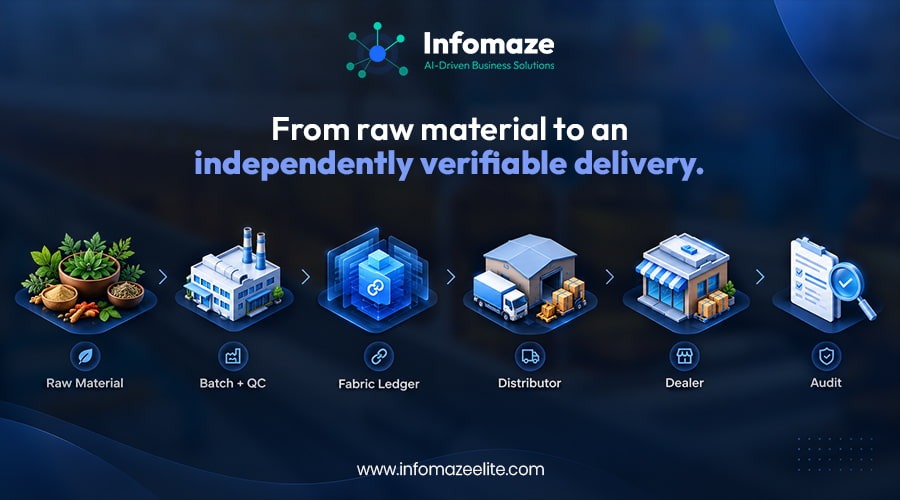
🌿
Raw Material
Sourced by manufacturer
🏭
Batch + QC
Recorded on-chain
⛓️
Fabric Ledger
Shared across peers
🚚
Distributor
Receipt + warehouse
🏪
Dealer
Allocation + fulfillment
🔍
Audit
Cross-checked by ID
🔐

Permissioned, not public

Only verified supply chain partners run a node. It's a private network among organizations that actually need to trust each other — not a public chain anyone can join.

🧾

Every event, signed and timestamped

Batch creation, QC sign-off, dispatch, and receipt are each recorded once, cryptographically signed, and impossible to quietly edit afterward.

🔗

Cross-checkable by design

A distributor's receipt record and the manufacturer's shipment record point to the same transaction ID. If they don't match, the gap is visible instantly.

🕵️

Private where it needs to be

Commercial terms and regional pricing stay in private channels between the two parties involved. Traceability doesn't mean everyone sees everyone's contracts.

SHARED ACROSS ALL PARTICIPANTS
  • Batch information
  • Manufacturing date
  • Product origin
  • Shipment status
  • Verification history
MANUFACTURER ↔ DISTRIBUTOR ONLY
  • Commercial agreements
  • Wholesale pricing
  • Contract terms
DISTRIBUTOR ↔ DEALER ONLY
  • Dealer pricing
  • Inventory allocations
  • Regional sales agreements
Independent Audit Verification

Because every organization holds its own copy of the ledger, no one has to take another party's word for what happened — each can check the shared transaction ID directly.

  1. Manufacturer creates Batch #B1001.
  2. The transaction is recorded on the blockchain and receives a unique transaction ID.
  3. Distributor receives the shipment and confirms receipt against that same ID.
  4. Dealer receives inventory from the distributor, again referencing the same ID.
  5. During an audit, any participant can pull its own record and check it against the ledger entry — if a record doesn't match, the discrepancy is visible immediately, with no reconciliation meeting required.
Manufacturer Record
Blockchain Transaction ID
Distributor Record
Dealer Record

What each organization owns — and what its audit dashboard shows.

Every participant runs its own peer node and gets a role-specific dashboard, so each organization can see what it's responsible for and independently audit its own activity against the shared ledger.

MANUFACTURER (INDIA)
  • Raw material procurement
  • Production planning & batch creation
  • Quality control & certificate generation
  • Export shipment management
WHOLESALE DISTRIBUTOR (USA)
  • Receiving shipments
  • Inventory & warehouse management
  • Distribution tracking
  • Dealer allocations
REGIONAL DEALERS
  • Product receipt confirmation
  • Inventory tracking
  • Product verification
  • Customer fulfillment

What actually changed once the ledger went live.

The shifts below reflect the operational changes the client saw after moving from disconnected spreadsheets to a shared, verifiable ledger.

Single

Source of truth. Batch, shipment, and certificate data live in one place instead of scattered across departments and partner spreadsheets.

Faster

Audits. Records that used to take days to assemble from multiple parties are now a lookup away, and each one is independently verifiable.

Tamper-proof

History. Once a transaction is written to the ledger, it can't be quietly edited — audits stop being an argument about whose version is correct.

Independent

Verification. Every organization can check its own records against the shared ledger without asking a central authority to vouch for anything.

Selective

Visibility. Commercially sensitive pricing and contract terms stay private between the two parties involved, even though traceability data is shared.

Provable

Origin. Customers asking where a product came from get an answer backed by a cryptographically signed record, not a spreadsheet.

The insight behind the architecture.

Most "supply chain visibility" projects default to a dashboard sitting on top of a normal database. That solves reporting, not trust. This client's real problem was that three independent companies needed to rely on the same record — and none of them wanted to be the one trusting somebody else's server.

🎯

The ledger only carries what needs trust

Logins and report downloads stay in a normal application database. Only the transactions partners need to independently verify go on-chain — which keeps the network fast and the audit trail meaningful instead of bloated.

🔐

Permissioned beats public for this use case

A public blockchain would have made every participant's shipment volumes and pricing visible to competitors. A permissioned network gave the same tamper-proof guarantees while staying limited to organizations that actually needed to be in it.

🧩

Trust without a middleman

The whole point was letting three separate companies rely on one record without any of them controlling it. A shared-but-distributed ledger does exactly that — no party owns the source of truth, so no party can quietly change it.

Most supply chain software promises visibility. What this client actually needed was closer to a legal handshake — a record all three parties could point to during an audit and know it hadn't been touched. That's a narrower problem than "supply chain visibility," and it's why a permissioned blockchain, not another dashboard, was the right tool.

Questions about blockchain-based supply chain traceability.

Why use blockchain instead of a regular database for supply chain tracking?

A regular database has an administrator who can edit any record. That works fine for internal operations, but it's a problem when three independent companies need to trust the same audit trail. A permissioned blockchain removes that single point of control — no one organization can quietly alter a transaction after it's recorded, which is what makes the ledger useful as an audit source.

What's the difference between a public blockchain and the permissioned network used here?

Public blockchains are open to anyone and make every transaction visible to the world. A permissioned network like Hyperledger Fabric only admits verified participants — the manufacturer, the distributor, and the regional dealers — and controls who can see which categories of data. That mix of shared trust and selective privacy is why permissioned chains fit enterprise supply chains better than public ones.

Does putting shipment data on a blockchain mean competitors or customers can see everything?

No. Batch and shipment status is shared across the network's participants, but private data collections keep commercially sensitive information — wholesale pricing, contract terms, regional sales agreements — visible only to the two organizations directly involved. The network is also permissioned, so outside parties aren't on it at all.

How does an audit actually work on this system?

Each organization pulls its own record of a transaction and checks it against the matching blockchain transaction ID. If the manufacturer's shipment record, the distributor's receipt record, and the ledger entry all reference the same ID and match, the record is confirmed. If they don't match, the discrepancy is visible immediately, without waiting on another company to respond to a records request.

Is routine application activity, like logins or report downloads, stored on the blockchain too?

No. Operational logs — logins, approval workflows, report downloads — stay in the application's own database, where they're useful for day-to-day monitoring. Only the transactions partners actually need to independently verify — batch creation, QC approval, shipment, receipt — are written to the blockchain.

Can this kind of system scale to more distributors or dealers later?

Yes — that's part of why Hyperledger Fabric was chosen over a simpler custom-built ledger. New participants join by standing up their own peer node and getting admitted to the network's access policy, rather than requiring a rebuild of the ledger's structure. The architecture was designed with the client's regional expansion plans in mind.

A fragmented, spreadsheet-driven supply chain became a shared ledger three independent companies could all trust.

Every batch, shipment, and certificate now moves through a system where no single party controls the record — and every party can prove their own piece of it. Audit prep that used to take days now starts with a lookup.

📊 BI Practice
Free Assessment
We find out why your dashboards aren't being used — and fix it.

🔒 ISO 27001 · No spam · Honest assessment