The AI workflow automation trends with real 2026 adoption are: narrow-scope agentic AI in regulated, high-volume functions; hyperautomation connecting RPA, AI, and APIs end-to-end; AI document processing replacing manual data entry; process mining before automating; and human-in-the-loop governance becoming standard rather than optional.
The trend that's mostly still hype: fully autonomous, department-wide AI agents — most enterprises still keep a human in the approval loop for anything consequential.
Agentic AI is real — but narrower than the marketing suggests
Agentic AI — systems that can take multi-step action inside a workflow rather than just answering a question — is the trend getting the most attention in 2026, and unlike some past AI hype cycles, there's real production usage behind it. Roughly a third of enterprises now have at least one AI agent live in production, though adoption is heavily concentrated: banking and insurance lead, while healthcare and government both lag well behind, largely because of regulatory exposure and legacy infrastructure that isn't built to support autonomous decision-making yet.
What's notable is where agentic AI is actually working: narrow, well-bounded workflows — approvals routing, fraud flagging, invoice exception handling — inside industries with high transaction volume and clear rules. It's succeeding as a specialist, not as a general-purpose replacement for a department. Most businesses deploying it keep a hybrid model, where routine decisions run autonomously and anything with real consequence still routes to a person.
For years, "automation" meant one tool doing one job — a bot filling a form, a script moving a file. Hyperautomation is the shift toward connecting AI, robotic process automation (RPA), APIs, and workflow platforms so an entire process runs end-to-end, across systems that previously required a human to bridge them manually. Market researchers now put hyperautomation on a steep growth curve, with the segment forecast to more than double over the next several years as companies move past single-point automations toward orchestrating whole processes.
What this looks like in practice:
an order that used to touch five separate systems — CRM, ERP, invoicing, shipping, support — now moves through all five without a person re-keying data at each handoff.
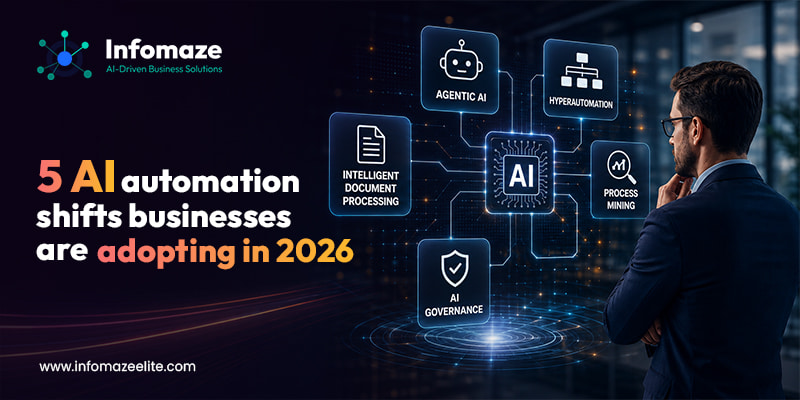
Of all the AI automation categories getting deployed in 2026, intelligent document processing — extracting, classifying, and routing data from invoices, contracts, and forms — has some of the clearest, most measurable payback. It's unglamorous compared to agentic AI, but it replaces a specific, high-volume, error-prone manual task with something a model does reliably at a fraction of the cost, which is exactly the kind of use case finance and operations teams can build a business case around without much debate.
A pattern showing up more in mature automation programs: mapping how a process actually runs today, using AI-powered process mining tools, before deciding what to automate. Automating a broken process just makes it fail faster and more expensively. Teams that mine the process first tend to find that the bottleneck isn't where they assumed — often a single approval step or a data handoff, not the task everyone wanted to automate first.
The honest counterweight to all of this: adoption is outpacing proven value. Gartner has projected that more than 40% of agentic AI projects will be cancelled by the end of 2027, largely over unclear ROI and weak risk controls — and PwC's most recent CEO survey found only a small minority of leaders reporting AI has delivered both cost and revenue benefits in the past year. That gap is why AI governance frameworks — clear rules for what an agent can decide alone, what needs sign-off, and how decisions get logged and audited — have gone from a nice-to-have to a prerequisite for any automation program leadership is willing to fund at scale.
"The gap isn't a technology problem. It's an organisational design problem — companies that redesign the workflow around AI see the returns; companies that bolt AI onto an unchanged process usually don't."
What actually separates the wins from the stalled pilots
- Scope is narrow and well-defined a specific workflow with clear rules, not "automate customer service."
- The process was redesigned, not just automated as-is the steps that only existed because a human was doing the work get removed, not preserved.
- Governance is built in from day one who can approve what, and how every automated decision gets logged, is decided before launch, not after an incident.
- There's a clear owner someone accountable for the workflow's performance, not just for switching the tool on.
- ROI is measured against the actual manual process it replaced, not against an optimistic vendor benchmark.
Where this leaves mid-market and growing businesses
Large enterprises still account for the bulk of automation spending, but that gap is closing — smaller and mid-market businesses are adopting AI automation at a faster growth rate than large enterprises right now, largely because the tools have gotten cheaper and more accessible, and because cost pressure and hiring constraints hit smaller teams harder. The businesses seeing the fastest payback tend to start with a single, high-friction process — usually something in finance, customer support, or document-heavy operations — rather than trying to automate broadly on day one.
Not sure which of your workflows are actually worth automating?
Our AI Audit maps your highest-friction processes, flags where agentic AI or hyperautomation genuinely applies, and where it doesn't — in 60 minutes, no obligation.