Off-the-shelf software exists for a reason. It's fast to set up, cheap to start with, and for a huge number of businesses it's genuinely the right call for years. We've spent over two decades building software for companies that range from five-person teams to enterprise operations, and we'd never tell a business to go custom just because custom sounds more impressive. Most of the time, the honest answer to "should we build something custom?" is still no.
But there's a point where the maths changes. It's rarely a single dramatic failure — off-the-shelf tools don't usually crash and burn. What actually happens is slower and easier to miss: your team quietly builds more workarounds every quarter, until one day someone adds up the hours spent working around the software instead of working with it, and the number is bigger than anyone expected.
Here are the five patterns that tell us a business has crossed that line — and what we'd recommend doing about each one.
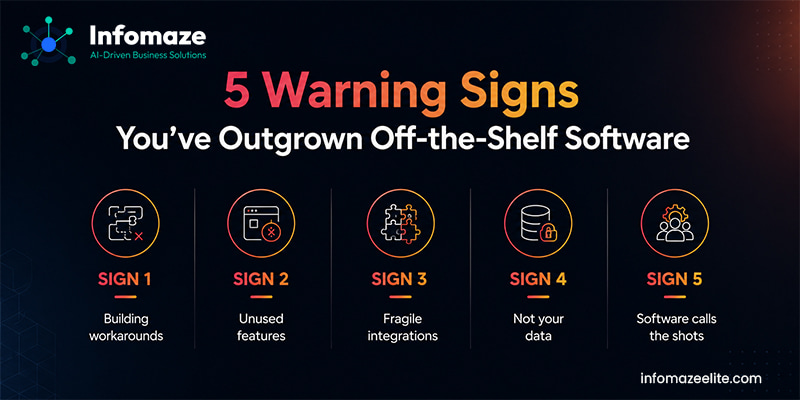
You're building workarounds instead of workflows
This is the clearest tell, and it's almost always the first one to show up. A team starts with the software doing 90% of the job, and over time the gaps get patched with spreadsheets, sticky notes, group chat threads, and "just remember to also do X" steps that live in someone's head rather than in the system. None of this happens because the team is disorganized — it happens because the software genuinely doesn't cover the part of the business that's grown past what it was built for.
Most off-the-shelf platforms price by tier, and most tiers are built around a bundle of features designed to appeal to as many businesses as possible — not your business specifically. That means a lot of companies end up paying for a "Professional" or "Enterprise" plan because they need two of its fifteen features, while the other thirteen sit untouched every single month.
Off-the-shelf tools are built to serve thousands of different businesses, which means their integrations are built for the average case, not your specific stack. A lot of companies end up stitching several tools together through a chain of automation platforms, CSV exports, and "sync every few hours" jobs that quietly break the moment one vendor changes their API.
Not sure whether you've outgrown your current software?
We offer a free 30-minute review — tell us what you're running today and we'll tell you honestly whether custom development makes sense, or whether your current setup just needs reconfiguring. No obligation, no generic pitch.
This one is easy to overlook until a business needs to do something the vendor never anticipated — a detailed audit, a migration, a merger, a new report that combines data in a way the platform's export tool wasn't built for. At that point, a business discovers just how much its own data is shaped by someone else's schema, not its own.
Off-the-shelf tools are built around a generic version of how a business "should" operate. Most of the time that's close enough. But some businesses have a genuinely specific way of working — a particular approval chain, a unique customer classification, an operational sequence that took years to refine — and forcing that process into a tool that wasn't built for it means either bending the process to fit the software, or building an awkward pile of exceptions around it.
"Off-the-shelf software rents you a process. Custom software builds you your own. Only one of those gets more valuable the longer you use it."
The honest answer to "should we just switch platforms?"
This is the question we hear most often from businesses in this position — not "should we go custom," but "should we just move to a different off-the-shelf tool that fits us better?" It's a fair question, and sometimes the answer is yes: if a business is on a genuinely wrong-sized platform for its stage, a different off-the-shelf tool can be the right call.
But in our experience, once a business has hit three or more of the five signs above, switching platforms usually just delays the same problem. A different vendor's software is still someone else's generic template, still priced per seat, still built around an average business rather than yours. The underlying issue — a process specific enough that no off-the-shelf tool fits it cleanly — travels with you to the next platform.
The real question isn't "which off-the-shelf tool fits us better?" It's "has our process gotten specific enough that no off-the-shelf tool will ever fit cleanly?" For a growing share of businesses we work with, the honest answer to that second question is yes — and that's the point where custom web application development stops being a luxury and starts being the cheaper long-term option.
Going custom doesn't have to mean replacing everything at once. Most of the successful projects we've run start with one specific application built around the single biggest gap — the process most patched together with workarounds — while the rest of the business keeps running on its existing tools. The full picture usually comes together over twelve to eighteen months, not in one release.
What a properly custom-built system actually looks like
After a well-scoped custom application replaces the gap in an off-the-shelf setup, the change is usually less dramatic than people expect and more useful than they hoped. The workaround spreadsheet disappears because the system finally covers that process. The team stops paying for fifteen features to get the two they need. Integrations stop breaking silently because they were designed as part of the system, not bolted on after the fact. Reports that used to require a manual rebuild now take one click, because the data model was built around the questions the business actually asks.
None of this requires exotic technology. It requires an honest look at where the off-the-shelf tool stopped fitting, and a build that's scoped around that gap specifically — which is exactly the kind of custom web application development work we do for businesses at this stage.
Infomaze Elite — Custom Application Development Practice, Mysore.
23+ years building web applications, portals, and business systems for clients across the USA, UK, Australia, and Canada.
See our web application development services →