A home goods retailer selling across Shopify, Amazon, and Walmart was running inventory, orders, and fulfillment through six separate tools and a stack of shared spreadsheets. We built a single custom web application that sits above all three sales channels and three warehouses — without replacing the storefront the retailer had already invested in.
Six tools, three sales channels, three warehouses, no single source of truth. We didn't rip anything out — we built the data layer that was missing.
The client sells home goods through their own Shopify storefront, an Amazon seller account, a Walmart Marketplace listing, and twelve wholesale retail partner accounts on top of that. By the time we got involved, the operations team of four people was running the business through six separate, unconnected tools: Shopify admin for the online store, a shared inventory spreadsheet that two people updated by hand, a third-party freight tracker for warehouse-to-warehouse transfers, a help desk tool for customer service tickets, a manually maintained reorder-point calculator in Excel, and a monthly export-import routine into QuickBooks for finance.
None of these systems talked to each other. A sale on Amazon didn't automatically reduce the stock count that Shopify or the wholesale team could see. Someone had to notice the sale, open the spreadsheet, and manually subtract the units — and during the retailer's peak season, when order volume climbed past 1,200 orders a day across all channels, that manual step started failing. SKUs oversold. Customers got "in stock" confirmation emails for items that had already sold out on a different channel two hours earlier.
Inventory data lived in six places, in six different formats, with no shared SKU standard between the wholesale spreadsheets and the Shopify catalog
Peak season order volume of 1,200+ orders/day meant zero tolerance for downtime during any migration or rebuild
A four-person operations team with no dedicated IT staff had to be able to run the new system day one, without a training ramp
Real-time stock sync was required across Shopify, Amazon, and Walmart simultaneously — a delay of even an hour was enough to cause overselling
The retailer had recently redesigned their Shopify storefront and could not justify replacing it — any solution had to work alongside it, not instead of it
The instinct in a situation like this is usually to recommend a full platform migration — move everything onto a single commerce suite and start over. That's rarely realistic for a retailer of this size. The Shopify storefront was working fine for customers; the problem wasn't the storefront, it was the absence of anything connecting it to the warehouse floor, the wholesale ledger, and the other two marketplaces. Replacing six tools with one giant platform would have meant months of re-training, a costly migration of years of order history, and a real risk of losing wholesale accounts during the transition.
So instead of a rebuild, we scoped a custom web application that would sit above all of it — reading from every existing system through its API, and giving the operations team one screen to work from instead of six.
We built the platform in two layers that could be deployed independently, which is what let the retailer keep operating normally while we rolled the system out in stages rather than a single risky cutover.
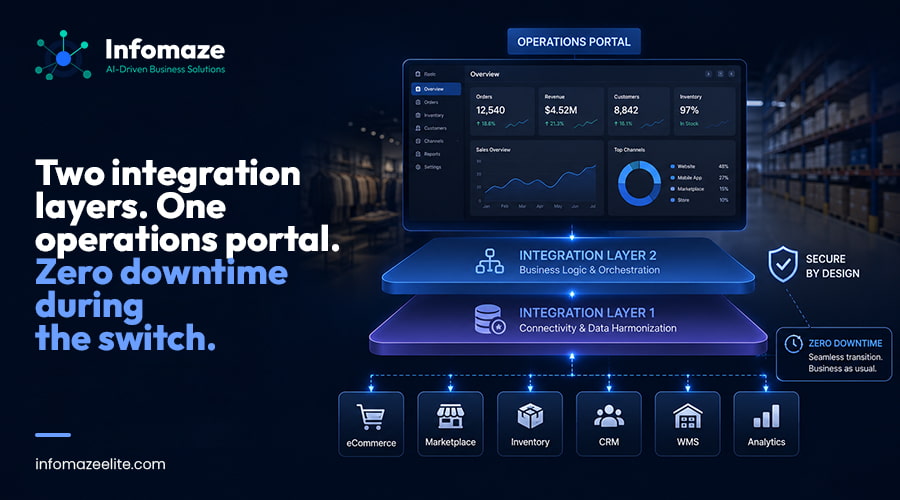
Built a custom SKU-mapping table that reconciled the retailer's internal product codes with the different formats used by Shopify, Amazon, and Walmart
Connected to Shopify, Amazon MWS, and the Walmart Marketplace API to pull orders and push inventory counts in near real time
Every sale on any channel triggers an inventory decrement that propagates to the other two channels within seconds, not hours
Warehouse transfers — previously tracked through a separate freight tool — now write directly into the same inventory ledger, so a transfer between warehouses updates available-to-sell stock automatically
A reconciliation job runs nightly to catch and flag any mismatch between channel-reported stock and the internal ledger, something the old spreadsheet process had no way of doing
A single web application login replaces the six separate tool logins the operations team used to juggle
A live inventory dashboard shows stock across all three warehouses and all three channels on one screen, with low-stock alerts replacing the manual Excel reorder calculator
An order fulfillment view pulls orders from every channel into one queue, so staff no longer switch between Shopify admin, Amazon Seller Central, and Walmart's portal to process shipments
A customer service panel shows order and inventory status side by side, so support staff can answer a stock or shipping question without opening a second tool
A finance export button replaces the old manual month-end QuickBooks import, generating a reconciled export directly from the unified order and inventory data
📊 Unified operations data model — reads from Shopify, Amazon, Walmart, and the internal warehouse ledger. Applies one canonical SKU standard across all channels. Feeds the inventory, fulfillment, and finance views from a single source of truth. The Shopify storefront itself was never touched.
We rolled the sync engine out first, running quietly in the background for three weeks while the team kept using their existing tools, so we could validate that stock counts matched reality before anyone's daily workflow changed. Only once the numbers were provably accurate did we switch the operations team over to the new portal, tool by tool, starting with inventory and finishing with the finance export — the piece with the least day-to-day urgency and the most room to get right slowly.
Most retailers in this position assume the fix is a bigger platform — replace Shopify, replace the spreadsheets, replace everything with one enterprise suite that promises to do it all. That's an expensive assumption, and for a business already generating consistent revenue through channels that work, it's usually the wrong one.
The insight that shaped this project was treating the existing tools as data sources rather than problems to be replaced. Shopify, Amazon, and Walmart were never the issue — each of them does its own job well. What was missing was a layer above them that could reconcile the data and give the operations team one place to act on it. Once we separated "where the data comes from" from "where the team works," the six-tool problem stopped being a platform migration and became an integration and interface problem — a much smaller, much less risky project.
You don't have to replace your storefront to unify your operations.
This pattern applies to any retailer running sales through more than one channel with no shared operational view — a custom web application built as an integration and interface layer is very often faster, cheaper, and lower-risk than a full commerce platform migration, because the systems that are already working for your customers stay exactly as they are.
Beyond the headline numbers, the operations team went from a two-week onboarding process for any new hire — because each of the six tools needed its own training — to a two-day onboarding on the single portal. The nightly reconciliation job has caught and flagged nine channel-level stock mismatches in the four months since launch, each one resolved before it reached a customer, something the old process had no mechanism to do at all.
The wholesale side of the business saw a change that wasn't part of the original brief but turned out to matter just as much. Because the twelve wholesale partner accounts were finally reading from the same stock ledger as Shopify, Amazon, and Walmart, the operations team stopped having to manually check availability before confirming a wholesale order — a step that used to take a phone call to the warehouse and, during busy weeks, a full day's delay before the partner got a confirmed ship date. That confirmation now happens in the portal in the time it takes to click a button, and it's one of the changes the client mentions most often when asked what the new system actually changed day to day.
Live stock across 3 warehouses and 3 channels, reorder alerts, mismatch flags
Unified order queue across Shopify, Amazon, and Walmart
Reconciled, ready-to-import data replacing the manual QuickBooks routine
We build the web application that sits above the tools you already have — no rip-and-replace required.