Enterprise Data AI Classification and Scoring Implementation: Case Study
Modern enterprises generate enormous volumes of operational, transactional, and behavioral data every second. However, without intelligent interpretation, this data remains passive and unable to guide automation, prioritization, or strategic decision-making.
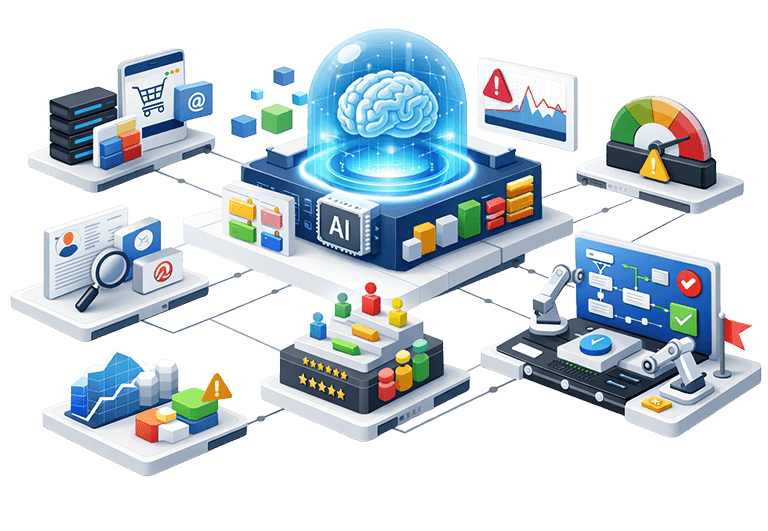
We at Infomaze designed and implemented an enterprise-grade AI-powered decision intelligence framework that converts fragmented enterprise datasets into dynamically scored, context-aware insights. By combining data classification services, AI lead scoring, predictive risk modeling, and AI risk scoring, the solution enabled enterprises to automatically classify records, detect anomalies, prioritize workflows, and drive real-time decision automation across complex systems.
Client Overview
Our client is a large-scale enterprise operating in a high-data-velocity environment, managing millions of records across CRM systems, operational system, customer interactions, and transaction workflows.
While the organization possessed extensive datasets, decision-making processes relied heavily on static rule engines and manual prioritization. This limited the ability to derive meaningful insights from the data and slowed operational response.
The enterprise required a scalable intelligence layer capable of combining data classification services, AI lead scoring, customer segmentation AI, and predictive risk modeling to support faster, more accurate decision-making.
Enterprise Data Prioritization and Decision Intelligence Challenges
Despite possessing extensive enterprise data assets, the organization struggled to convert data into reliable decision intelligence. Operational inefficiencies emerged due to fragmented scoring models, lack of contextual classification, and limited predictive capabilities.
Lack of Intelligent Record Classification
Our client struggled to categorize enterprise records with contextual meaning. Without structured data classification services and intelligent data segmentation, teams manually interpreted data relevance, resulting in inconsistent tagging and unreliable categorization across systems.
Inefficient Operational Prioritization
Their enterprise processed large volumes of records without dynamic prioritization logic. High-value opportunities were buried within low-priority queues, delaying response times and preventing teams from focusing on the most critical workflows.
Fragmented Scoring and Predictive Models
Our client maintained separate scoring systems across departments. Without a unified architecture for AI lead scoring, AI credit risk assessment, and AI risk scoring, conflicting indicators and inconsistent evaluation logic reduced decision accuracy.
Reactive Risk and Fraud Detection
They relied primarily on rule-based alerts that identified risks only after incidents occurred. Without proactive fraud detection AI and predictive risk modeling, early warning signals and behavioral anomalies remained undetected.
Limited Data Reliability and Trust
Their organization lacked confidence in the accuracy and completeness of enterprise datasets. Without structured enterprise data enrichment and reliability scoring, decision-makers struggled to trust the intelligence generated by existing systems.
Static Systems Unable to Adapt to Behavioral Changes
Our client’s legacy models could not evolve with changing enterprise data patterns. Without adaptive learning or continuous predictive risk modeling, scoring accuracy degraded over time, requiring constant manual recalibration.
Enterprise AI Classification and Intelligent Scoring Framework
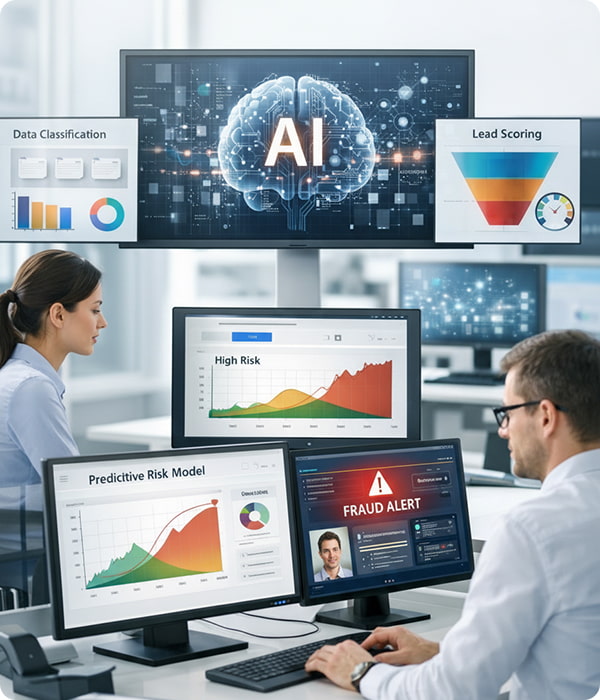
To address these challenges, Infomaze developed a scalable AI-driven intelligence framework combining data classification services, AI lead scoring, predictive risk modeling, and fraud detection AI into a unified decision system.
This architecture enabled organizations to convert raw enterprise data into prioritized insights through automated classification, scoring, and decision automation.
Infomaze developed a semantic AI classification layer capable of automatically understanding and categorizing enterprise records across multiple systems.
This system provided advanced data classification services that analyzed context, relationships, and entity attributes to generate meaningful classifications.
Key Capabilities
- NLP-based entity recognition and contextual classification
- Dynamic taxonomy generation using unsupervised learning
- Cross-system classification consistency
- Real-time classification during data ingestion
By enabling intelligent categorization and intelligent data segmentation, the platform significantly improved enterprise data usability.
Infomaze implemented a unified predictive scoring architecture capable of evaluating enterprise entities across multiple business dimensions simultaneously.
The framework integrated AI lead scoring, AI credit risk assessment, and predictive risk modeling to provide comprehensive insights for operational and strategic decisions.
Key Capabilities
- Lead quality evaluation using AI lead scoring models
- Customer value prediction using customer segmentation AI
- Behavioral signal aggregation across hundreds of attributes
- Continuous recalibration of scores based on new interactions
This multi-dimensional scoring model improved forecasting accuracy while enabling more reliable prioritization.
Infomaze introduced a dynamic prioritization engine that automatically ranks enterprise records based on predicted impact and urgency.
By combining AI lead scoring, AI risk scoring, and operational signals, the engine ensured that the most important records received immediate attention.
Key Capabilities
- Workflow priority scoring for operational tickets
- Revenue impact–based lead prioritization
- SLA-aware urgency prediction
- Automated routing and queue optimization
This intelligent prioritization significantly improved operational response time and efficiency.
To proactively identify threats and anomalies, Infomaze implemented a predictive risk intelligence system using fraud detection AI and predictive risk modeling.
The platform continuously analyzed behavioral patterns to identify high-risk transactions or suspicious activities before escalation.
Key Capabilities
- Transaction risk analysis using AI risk scoring
- Behavioral anomaly detection models
- Fraud probability estimation with fraud detection AI
- Explainable outputs for transparent risk assessment
This system enhanced enterprise security while reducing false positive alerts.
Infomaze implemented a data trust evaluation system to strengthen decision confidence through measurable reliability indicators.
The framework combined enterprise data enrichment with automated confidence scoring to evaluate record quality.
Key Capabilities
- Data completeness scoring models
- Accuracy confidence measurement
- Record trustworthiness index
- Automated reliability tagging
These capabilities significantly improved enterprise confidence in decision intelligence.
Infomaze implemented continuous learning pipelines enabling the system to evolve as new enterprise data became available.
Through adaptive feedback loops and predictive risk modeling, the system continuously improved scoring accuracy and prioritization logic.
Key Capabilities
- Event-driven model retraining
- Automated drift detection
- Self-improving scoring algorithms
- Continuous learning from enterprise outcomes
This adaptive framework ensured long-term intelligence accuracy.
Why AI Decision Intelligence Matters for Enterprise Leaders
Enterprise leaders require reliable intelligence systems capable of supporting high-speed decisions across complex environments. AI-powered decision frameworks enable organizations to transform raw data into actionable insights.
CTO: Scalable Intelligent Infrastructure
- Transition from rule-based automation to scalable AI decision infrastructure across enterprise applications.
- Unified intelligence layer supporting data classification services and enterprise data orchestration.
- Reduced engineering dependency for workflow prioritization logic.
- Architecture designed to process millions of real-time enterprise events.
CEO: Revenue Growth and Strategic Advantage
- Faster identification of high-value opportunities using AI lead scoring.
- Reduced operational inefficiencies through automated prioritization.
- Early risk identification powered by AI risk scoring and predictive risk modeling.
- Measurable ROI from enterprise AI automation initiatives.

Results & Business Impact
The implementation delivered measurable improvements across operational efficiency, risk management, and decision-making speed.
Significant improvement
Improved velocity through automated AI classification.
Efficiency increased
With intelligent workflow prioritization and automated routing.
Enhanced risk prevention
Proactive AI Fraud Detection for Stronger Risk Prevention.
Higher conversion rates
Advanced AI Lead Scoring Drives Higher Conversion Rates.
Improved enterprise data
Through automated enterprise data enrichment.
Conclusion
For modern enterprises, data alone is not enough to drive competitive advantage. Organizations must convert raw information into actionable intelligence capable of guiding automation, prioritization, and strategic decision-making.
By implementing an enterprise-grade framework combining data classification services, AI lead scoring, AI risk scoring, predictive risk modeling, and fraud detection AI, Infomaze enabled the organization to transition from reactive operations to intelligent decision automation.
Through customer segmentation AI, intelligent data segmentation, and scalable enterprise data enrichment, the platform transformed fragmented enterprise datasets into reliable decision intelligence.
For Fortune 500 environments where speed, accuracy, and scalability define success, AI-powered prioritization frameworks are no longer optional—they are essential infrastructure for modern enterprise operations.
Do you have a use case like this one?
Let us know! Our product experts can configure the best solution for your business.