AI-Powered Intelligent Document Processing for Unstructured Data: Case Study
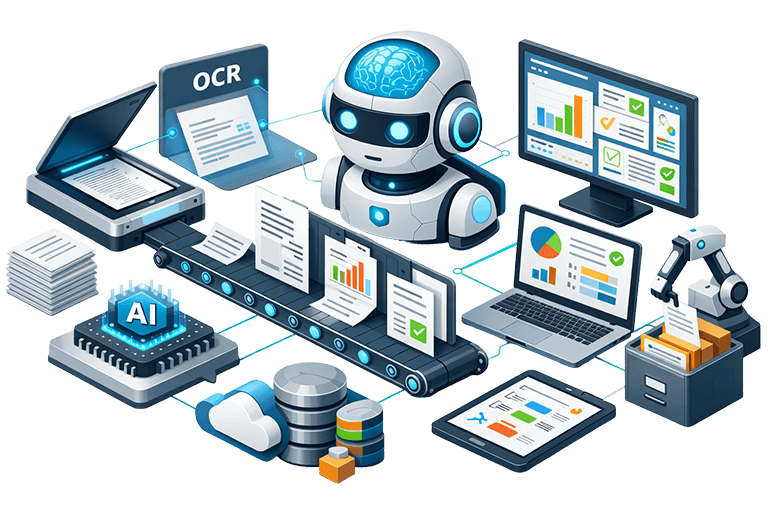
According to industry research, nearly 80 to 90% of enterprise data exists in unstructured formats, with documents forming the backbone of operational workflows. As enterprises seek efficiency and accuracy, Intelligent Document Processing (IDP) is emerging as a critical automation capability. This case study explores how Infomaze developed an enterprise-grade AI document intelligence framework that transforms high-volume enterprise documents into validated, workflow-ready structured data using advanced OCR data extraction, AI document processing, and document automation technologies.
Client Overview
The client operates in a document-intensive enterprise environment where thousands of operational documents are processed daily. These include PDF files, scanned documents, invoices, compliance forms, structured reports, and email attachments that contain critical operational and financial information.
Before implementing an AI document processing framework, the organization relied heavily on manual document workflows. Teams manually performed data extraction from invoices, reports, and contracts, validated information in spreadsheets, and processed approvals through email-based communication. This fragmented approach significantly slowed document workflows.
Enterprise Intelligent Document Processing Challenges
Modern enterprises face complex document processing barriers when dealing with high-volume unstructured information. Our client experienced several operational limitations that prevented efficient intelligent document processing and document automation solutions.
Data Locked in Unstructured Documents
Our client struggled because most operational information existed in PDFs, scanned files, invoices, contracts, and email attachments, preventing structured data extraction into ERP or CRM systems. As a result, critical document intelligence remained inaccessible for automation, analytics, or decision workflows.
High Manual Processing Cost
Manual invoice data extraction, contract data extraction, and document validation required significant human effort. Even a small 2% error rate in manual data extraction across thousands of documents created reconciliation issues, compliance risks, and operational delays.
Traditional OCR Data Extraction Limitations
Standard OCR tools struggled with real-world enterprise documents. Our client frequently faced issues with variable document layouts, low-quality scans and multi-language documents. As a result, OCR data extraction accuracy often dropped below 80%, limiting the reliability of automated document processing workflows.
Lack of Contextual Understanding
The existing system could extract isolated fields but lacked AI document intelligence capable of interpreting meaning.
Without contextual AI models, the system could not reliably identify contract clauses, invoice details, relationships between document entities, or hidden risk indicators.
Absence of Confidence Scoring
Enterprise compliance standards require explainable and auditable automation. However, the client’s system lacked confidence scoring for extracted data and audit logs for regulatory compliance. This created governance risks in financial and operational document workflows.
Slow Decision Workflows
After data extraction from invoices, contracts, and reports, teams still relied on email-based approvals and spreadsheet validations. This significantly increased document processing latency and prevented real-time automated document processing across enterprise systems.

AI-Powered Intelligent Document Processing Solution
To address these challenges, Infomaze developed a scalable AI document intelligence architecture designed to convert high-volume enterprise documents into structured, operational data.
The solution combined intelligent document processing, AI document processing models, advanced OCR data extraction, and automated document processing pipelines to enable reliable enterprise document automation.
Enterprise environments handle diverse document types including invoices, contracts, compliance reports, PDFs, scanned files, and email attachments.
We implemented a multi-format ingestion engine that included:
- Unified document ingestion APIs
- Scan enhancement and preprocessing pipelines
- Format normalization systems
- Event-driven document processing architecture
This ensured reliable ingestion for downstream AI document processing and data extraction workflows.
To overcome traditional OCR limitations, we implemented AI-powered OCR data extraction models capable of understanding complex document layouts.
Key capabilities included:
- Layout-aware deep learning OCR
- Handwriting recognition models
- Multi-language document processing
- Structural segmentation of tables and fields
This significantly improved invoice data extraction, contract data extraction, and document field recognition accuracy.
Unlike rule-based extraction engines, the solution used transformer-based NLP models capable of contextual document understanding.
This enabled:
- Semantic key-value data extraction
- Line-item and table reconstruction
- Named entity recognition
- Relationship mapping across document fields
- Intent detection in contracts and reports
This layer delivered advanced AI document intelligence for automated document processing.
Using machine learning models, documents are automatically classified and routed to relevant enterprise systems.
Capabilities included:
- ML-based document categorization
- Automated tagging and indexing
- Workflow-triggered document routing
- ERP and CRM integration APIs
This significantly accelerated document automation solutions for enterprise workflows.
To improve governance and compliance, we integrated advanced validation layers into the intelligent document processing framework.
These included:
- Confidence scoring for extracted data fields
- Cross-field logical validation
- AI-powered anomaly detection
- Human-in-the-loop exception review
This ensured accurate automated document processing with compliance-grade traceability.
Enterprise document environments evolve constantly. Static models quickly lose accuracy.
To maintain performance, the system included:
- Active learning pipelines
- User correction feedback loops
- Automated model retraining
- Performance monitoring dashboards
This ensured continuous improvement in AI document processing accuracy and document automation efficiency.
Why Intelligent Document Processing Matters for Enterprise Decision Makers
Modern enterprises cannot scale digital transformation without reliable AI document processing and intelligent document processing infrastructure. Both technical and executive leaders benefit significantly from enterprise-grade document automation solutions.
For the CTO – Engineering Efficiency
Reduced Technical Debt:
Eliminates fragile scripts and replaces them with scalable intelligent document processing infrastructure.
Cloud-Native Architecture:
Enables scalable AI document processing systems with API-driven integrations across enterprise applications.
AI-Ready Data Infrastructure:
Transforms unstructured documents into structured data ready for analytics and enterprise automation.
For the CEO – Operational and Financial Impact
Reduced Manual Data Entry:
Automated document processing reduces manual data entry workloads across invoices, reports, and contracts.
Faster Operational Decisions:
AI document intelligence accelerates document-to-decision workflows across enterprise operations.
Operational Cost Efficiency:
Document automation solutions reduce labor-intensive processing and improve operational productivity.
Improved Compliance Governance:
Structured document processing enables transparent audit trails and regulatory compliance monitoring.

Results & Business Impact
Following deployment of the AI document intelligence framework, the client achieved measurable improvements.
Faster Document Processing
Significant reduction in enterprise document processing cycle time.
Automated Manual Data Entry Processes
80–95% decrease in manual data entry efforts.
Enhanced Data Extraction Accuracy
Contextual AI models improve document data extraction accuracy.
Real-Time Integration
Real-time workflows integrated with ERP and CRM systems.
Compliance Visibility
Validation and audit logs ensure strong compliance traceability.
Conclusion
As enterprises generate increasing volumes of document-based data, manual processing models are no longer sustainable. Through AI document processing, intelligent document processing infrastructure, and advanced OCR data extraction, Infomaze transformed the client’s document ecosystem into a structured, validated, enterprise-grade intelligence layer.
Rather than simply digitizing documents, the solution enabled AI document intelligence that powers automated workflows, accurate data extraction, and faster enterprise decision-making.
In the modern enterprise landscape, intelligent document processing is not just operational support, it is foundational infrastructure for scalable digital transformation.
Do you have a use case like this one?
Let us know! Our product experts can configure the best solution for your business.